

TL;DR:
- Australian mining laws are state-based, with distinct regulations in NSW and Victoria.
- Proper licensing, compliance, and understanding of each state's procedures are essential to avoid enforcement issues.
- Ongoing obligations like reporting, expenditure, and community engagement are critical for maintaining licences and project success.
Many prospectors assume that once you understand mining law in one Australian state, you understand it everywhere. That assumption has ended careers and stalled multimillion-dollar projects. The reality is that mining law in Australia is state-based, meaning NSW and Victoria each operate under distinct legislation, with separate licensing systems, enforcement mechanisms, and compliance timelines. A fossicking licence valid in one state may be completely irrelevant across the border. This guide cuts through the confusion, covering the key laws, licence types, application steps, edge cases, and ongoing obligations you need to stay compliant and keep your project moving forward.
Table of Contents
- Understanding the legal framework: Mining laws in NSW and Victoria
- Licensing and compliance essentials: Types, conditions, and key differences
- Step-by-step: How to apply for and maintain a mining or exploration licence
- Nuances and edge cases: Fossicking, retention, and low-impact licences
- Expert perspective: What most guides miss about compliance and success
- Explore smarter: Tools and resources for compliant exploration
- Frequently asked questions
Key Takeaways
| Point | Details |
|---|---|
| State-specific laws matter | NSW and Victoria have separate mining legislation and compliance expectations meaning requirements differ sharply by location. |
| Licensing is just the start | Ongoing reporting, environmental, and community obligations are central to legal operation and renewal. |
| Be proactive with edge cases | Low-impact and fossicking licenses, renewal limits, and landholder consent can create unexpected hurdles if overlooked. |
| Comprehensive compliance prevents penalties | Minor oversights are a major cause of fines and licence loss—staying up to date and organized is key. |
Understanding the legal framework: Mining laws in NSW and Victoria
Australia does not operate under a single national mining code. Each state controls its own mineral resources and sets the rules for who can explore, extract, and rehabilitate land. For professionals working in New South Wales and Victoria, this means two separate regulatory worlds, each with its own logic.
In NSW, the governing statute is the Mining Act 1992, which covers everything from exploration licences to mining leases and fossicking permits. Victoria operates under the Mineral Resources (Sustainable Development) Act 1990, commonly called the MRSDA. While both acts pursue broadly similar goals, the pathways they create are meaningfully different. The NSW and Victoria prospecting best practices guide offers a solid introduction to how these differences play out in the field.
"Australian mining laws are state-based; NSW governed by Mining Act 1992, Victoria by Mineral Resources (Sustainable Development) Act 1990. Exploration requires specific licences for compliance."
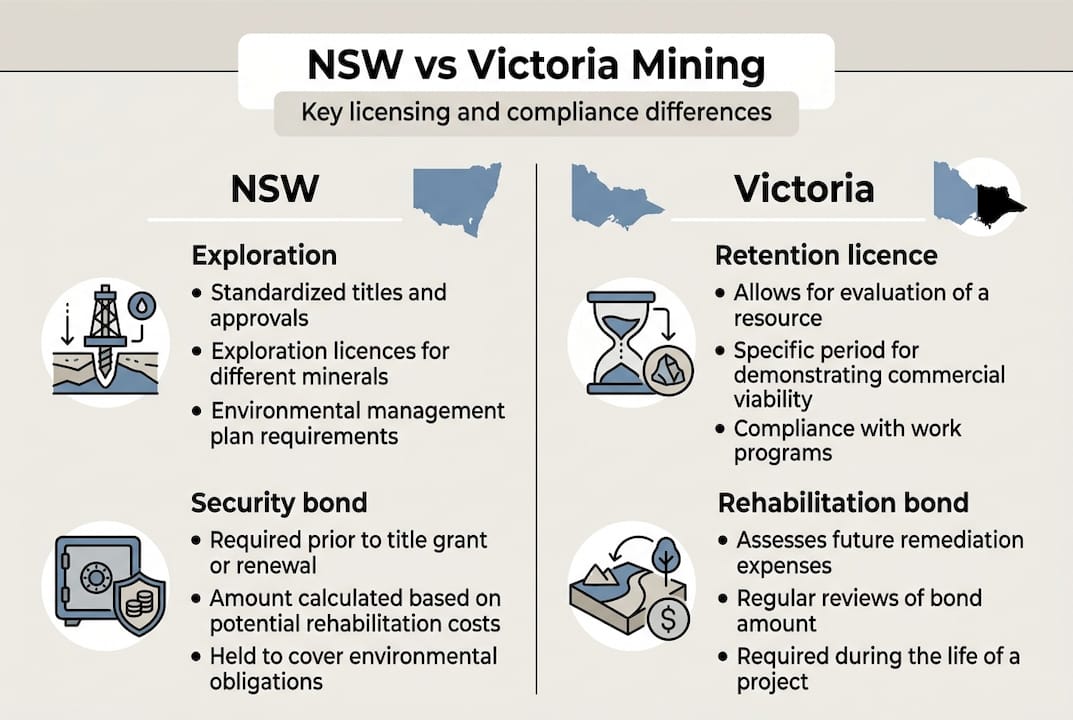
Here is a quick comparison of the two frameworks:
| Feature | NSW | Victoria |
|---|---|---|
| Governing act | Mining Act 1992 | MRSDA 1990 |
| Regulator | NSW Resources | Earth Resources Regulation |
| Fossicking permit | Fossicking licence | Miner's Right |
| Public advertising required | No | Yes |
| Native Title checks | Required | Required |
| Rehabilitation mechanism | Security deposit | Rehabilitation bond |
Key structural differences to note:
- Victoria requires public advertising of exploration applications, opening a formal community comment period.
- NSW does not mandate public advertising but enforces strict general conditions on every licence.
- Both states require Native Title assessment for any new tenement, which can significantly extend approval timelines.
- Victoria mining regulations set specific minimum annual expenditure thresholds tied to licence area size.
Understanding which act governs your intended area is step one. Mixing up your obligations under these two frameworks is not a minor administrative error. It is the kind of mistake that triggers enforcement action.
Licensing and compliance essentials: Types, conditions, and key differences
Once you know which state's framework applies, the next question is which licence you actually need. Both states offer a tiered system, but the categories and conditions are not interchangeable.
In NSW, the main licence types include exploration licences (covering mineral, coal, and low-impact categories), mining leases, and fossicking licences for recreational prospectors. The Mining Act 1992 subjects all of these to general conditions covering environmental management, rehabilitation, public safety, and community engagement. Breaches are statutory offenses, not just administrative slip-ups.
Victoria's system includes exploration licences, retention licences for viable but not yet economically productive deposits, and the Miner's Right for recreational use. Under the MRSDA, mineral exploration licence applicants must submit a geological report, a detailed work program, and proof of financial capacity. Holders must minimize environmental impacts, engage local communities proactively, and lodge annual reports. Proceeding to mining requires a separate plan, bond, and insurance.
A side-by-side look at compliance conditions:
| Condition | NSW | Victoria |
|---|---|---|
| Environmental management | Mandatory | Mandatory |
| Annual reporting | Required | Required |
| Community engagement | Required | Required |
| Public advertising | Not required | Required before grant |
| Minimum expenditure | Not always prescribed | Yes, by area size |
| Enforcement | Prosecution for offenses | Fines, added conditions, prosecution |
Pro Tip: Before lodging any application, verify whether your target site overlaps with existing tenements or Native Title claims. Unresolved overlaps are the single most common cause of application delays in both states. Use the exploration tips for NSW and Victoria to sharpen your pre-application research.
For a focused breakdown of Victorian licence conditions, the Victoria licence rules guide provides detailed guidance. And for a broader view of how the NSW vs Victoria approval process compares across both jurisdictions, specialist legal resources are worth reviewing before you commit resources.
Step-by-step: How to apply for and maintain a mining or exploration licence
Knowing what licence you need is one thing. Navigating the actual application and keeping the licence in good standing is where many professionals hit unexpected obstacles.
Applying in NSW:
- Identify the licence type that matches your proposed activity.
- Check for existing tenements and Native Title status over your target area.
- Lodge your application via the NSW Resources online portal with all supporting documents.
- Await assessment and respond to any requests for additional information.
- On grant, acknowledge and comply with all attached general conditions.
Applying in Victoria:
- Prepare a geological report, work program, and financial capacity documentation.
- Lodge your application, triggering a mandatory public advertising period.
- Respond to any community or landholder submissions received during that period.
- Satisfy Native Title checks and any additional technical requirements.
- On grant, begin compliance with expenditure and reporting obligations immediately.
Here is what the expenditure and reporting picture looks like in practice:
| Licence area (Victoria) | Minimum annual expenditure |
|---|---|
| Up to 5 ha | $15,000 per year |
| Larger areas | Scaled minimum (varies) |
Exploration expenditure minimums in Victoria are not suggestions. Failing to meet them is grounds for licence cancellation. In NSW, prescribed rehabilitation conditions under Mining Regulation 2016 Schedule 8A set enforceable standards for how sites must be restored.
For maintaining any licence, expect to:
- Submit annual technical reports detailing work completed.
- Meet or exceed minimum expenditure thresholds.
- Report any material changes to your work program promptly.
- Renew before expiry, satisfying any updated conditions.
Pro Tip: Set calendar reminders at least 90 days before your licence renewal date. Last-minute renewals often lead to missed documentation requirements, which regulators in both states treat seriously. Good prospecting site selection tools can also help you efficiently document site work for annual reports.
Nuances and edge cases: Fossicking, retention, and low-impact licences
Beyond the standard exploration and mining licence pathway, several less-discussed categories deserve attention. Getting these wrong can result in enforcement action even when you thought you were operating legitimately.
Fossicking licences and the Miner's Right
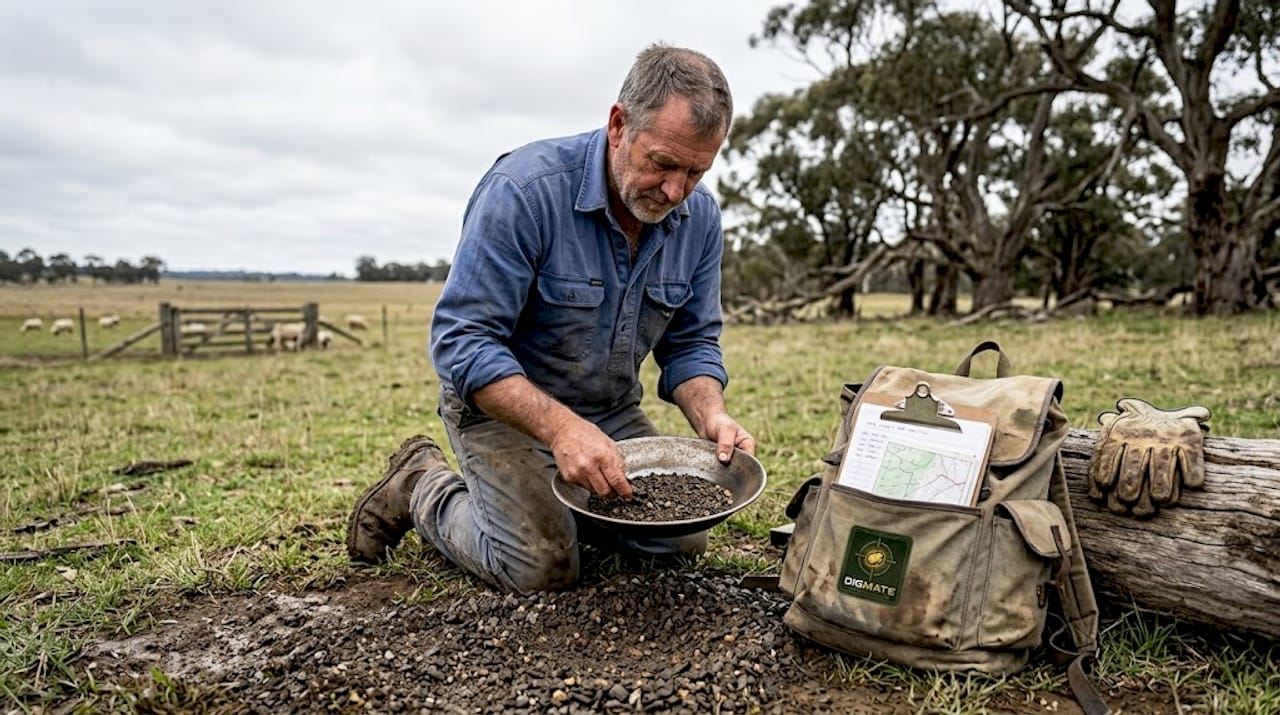
Both states offer entry-level access for recreational prospectors. In NSW, a fossicking licence costs $48 for two years. Victoria's Miner's Right is $25 for ten years. Both are strictly recreational with no commercial use allowed. Equipment restrictions apply in both states, and accessing private land always requires landholder consent.
Victoria's retention licence
If you identify a deposit that is technically viable but not yet economically productive, Victoria offers a retention licence to hold your position. However, there is a hard cap: retention licences allow a maximum of two renewals. After that, you must convert to a mining licence or surrender the tenement.
Low-impact exploration codes
Victoria's low-impact exploration code covers specific activities that can proceed without a full work plan. This is a useful pathway but has limits. Activities like diamond drilling are typically not classified as low-impact, meaning they require a formal work plan regardless of intent. And on private land, even low-impact activities may need explicit landholder consent.
"Low-impact exploration follows the code but may need landholder consent on private land; retention licences cover viable but uneconomic deposits with a maximum of 2 renewals; diamond drilling often requires a formal work plan."
Special categories to watch:
- Opal prospecting in NSW operates under a separate licence structure with its own conditions.
- Large equipment use in fossicking areas is generally prohibited under both state frameworks.
- Diamond or deep drilling in Victoria requires a formal work plan even if other exploration on the same licence area qualifies as low-impact.
Pro Tip: Always confirm which activity category applies to each specific technique you plan to use on site, not just the overall licence class. The gem prospecting tools and strategies resource and ground scan exploration technology platform can help you pre-screen sites and match activities to the right compliance pathway.
Expert perspective: What most guides miss about compliance and success
Most compliance failures we see among exploration companies and prospectors do not come from ignorance of the headline rules. They come from treating the licence grant as the finish line rather than the starting line.
Getting your exploration licence approved is genuinely the easy part. The ongoing obligations, annual reports, expenditure benchmarks, and community engagement duties are where many professionals quietly fall behind. Victoria inspectors can add conditions, levy fines, or pursue prosecution for serious non-compliance. NSW treats breaches as statutory offenses. Neither state treats "I didn't realize" as a defense.
The other underrated issue is Native Title. The right to negotiate applies to any new tenement that overlaps with a registered claim, and failing to engage that process correctly has derailed otherwise solid projects. The practical mineral exploration insights from professionals who have worked through this process are invaluable.
Successful explorers build compliance into their operational calendar from day one, not as a reactive task but as a core workflow. Minor licence variations, condition amendments, and renewal windows need to be tracked proactively. The professionals who stay out of trouble are the ones who treat their regulator as a long-term relationship, not a box to check at application time.
Explore smarter: Tools and resources for compliant exploration
Staying compliant across two distinct state frameworks, while also running efficient field operations, is a real challenge. That is where the right technology makes a measurable difference.

DigMate brings together AI-driven mineral detection, geospatial mapping, and integrated compliance resources into a single platform built specifically for prospectors and exploration companies in NSW and Victoria. From initial site screening to tracking your licence obligations, DigMate is designed to support every stage of the exploration lifecycle. You can also access free gold prospecting maps to sharpen your site selection before you even lodge an application. Smart prospecting starts with the right tools.
Frequently asked questions
How do I choose between a NSW fossicking licence and a Victorian Miner's Right?
Choose based on your intended activity location. The NSW fossicking licence costs $48 for two years, while Victoria's Miner's Right is $25 for ten years. Both restrict commercial use and require landholder consent on private land.
What are the main ongoing compliance obligations after securing an exploration licence?
You must submit annual technical reports, meet minimum work and expenditure thresholds, manage environmental impact, and fulfill all site rehabilitation duties. Annual expenditure minimums in Victoria are enforced strictly, and NSW rehabilitation conditions are prescribed under regulation.
Do I need landholder consent for low-impact exploration in Victoria?
Yes. Even when operating under the low-impact exploration code, private land access may require explicit landholder consent, especially for activities that could disturb the surface.
How do rehabilitation and security deposits differ in NSW and Victoria?
NSW requires security deposits to guarantee rehabilitation obligations. Victoria requires a rehabilitation bond plus insurance before mining commences. Both mechanisms ensure the site is properly restored after activity ends.
What happens if I breach mining licence conditions?
In NSW, breaches are statutory offenses that can lead to prosecution. In Victoria, inspectors can fine, add licence conditions, or pursue prosecution depending on the severity of the non-compliance.