
TL;DR:
- Exploration companies conduct staged, high-risk investigations to identify viable mineral deposits early.
- Most exploration projects do not result in mines, but they are vital for future resource development.
- Junior explorers play a crucial role in Australia's mining pipeline by generating 70 to 80 percent of new discoveries.
Mineral extraction gets all the headlines, but the real decisions that determine whether a mine ever opens happen much earlier, in the ground-level work of exploration. Most people picture mining as trucks, shafts, and processing plants. What they overlook is the intricate, high-stakes work that exploration companies carry out long before any of that machinery arrives. This article breaks down exactly what exploration companies do, how they differ from producers, why junior explorers are the backbone of Australia's resource pipeline, and what frameworks experienced mining professionals can use to evaluate and support exploration-stage projects.
Table of Contents
- Setting the scene: The exploration stage in mining
- What exploration companies actually do
- Explorers vs producers: Key differences and risks
- Why juniors matter: The pipeline for Australia's mining future
- What most mining guides miss about exploration companies
- Take your exploration further with innovative prospecting tools
- Frequently asked questions
Key Takeaways
| Point | Details |
|---|---|
| Exploration is high risk | Exploration companies take on major financial and technical risk to locate valuable mineral deposits. |
| Juniors drive discoveries | Junior companies are responsible for the vast majority of new mineral finds, sustaining future mining. |
| Regulatory compliance is crucial | Australian explorers must adhere to strict licensing and reporting frameworks like the JORC Code. |
| Success rarely means production | Most exploration projects don’t become mines, but their success ensures a pipeline of opportunities for larger producers. |
Setting the scene: The exploration stage in mining
Mineral exploration is not a single activity. It is a sequence of increasingly focused, increasingly expensive investigations designed to answer one core question: is there enough of a valuable mineral here to justify mining it? This is where the entire mining value chain begins, and it is also where most projects quietly die.
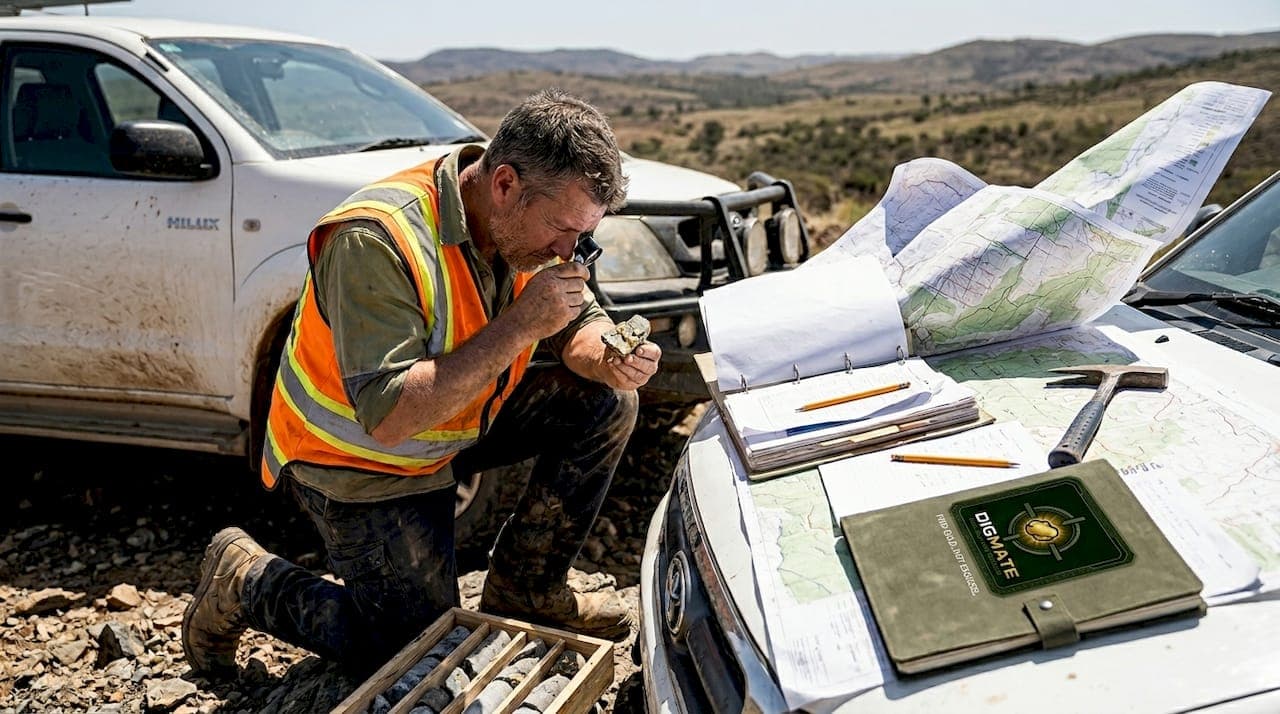
Exploration companies identify and define mineral deposits through staged programs including geological surveys, sampling, geophysics, and drilling, operating at the earliest stages before any production decision is made. Each stage requires capital, expertise, and a tolerance for uncertainty that few industries can match. A project can pass through years of survey work, drilling campaigns, and resource estimation before an investor or producer decides it simply is not worth developing.
"The majority of exploration programs will not result in a mine. That is not failure. That is the business of exploration."
Understanding this reality is critical for anyone working in or investing in Australian mining. The high-risk, high-reward nature of exploration is not a bug in the system. It is the design. You cannot know what is in the ground until you look, and looking costs money. The prospecting best practices that separate profitable exploration programs from expensive dead ends are often forged in this exact crucible of uncertainty.
The core stages of a typical exploration program include:
- Regional reconnaissance: Broad geological mapping and remote sensing to prioritize target areas
- Geochemical sampling: Soil, rock, and stream sediment analysis to detect anomalous mineral concentrations
- Geophysical surveys: Airborne or ground-based techniques such as magnetometry and induced polarization to reveal subsurface structures
- Exploratory drilling: Reverse circulation and diamond drilling to extract core samples and confirm mineralogy
- Resource estimation: Statistical modeling of drill data to define the size and grade of a deposit
Each step filters the probability. Most targets fall out. Only the strongest make it to the next phase.
What exploration companies actually do
Understanding the daily operations of an exploration company helps distinguish genuine prospect generators from speculative vehicles. These are not passive entities holding ground and waiting for luck. They are active, technical businesses running structured programs with defined milestones.
In Australia, the regulatory process begins before a single sample is collected. Exploration companies secure licenses from state governments, with the process varying by jurisdiction across New South Wales, Victoria, Western Australia, and elsewhere. These licenses grant the right to access and investigate defined areas, and they come with expenditure commitments and reporting obligations.
Once on the ground, the structured workflow of a professional explorer typically follows this sequence:
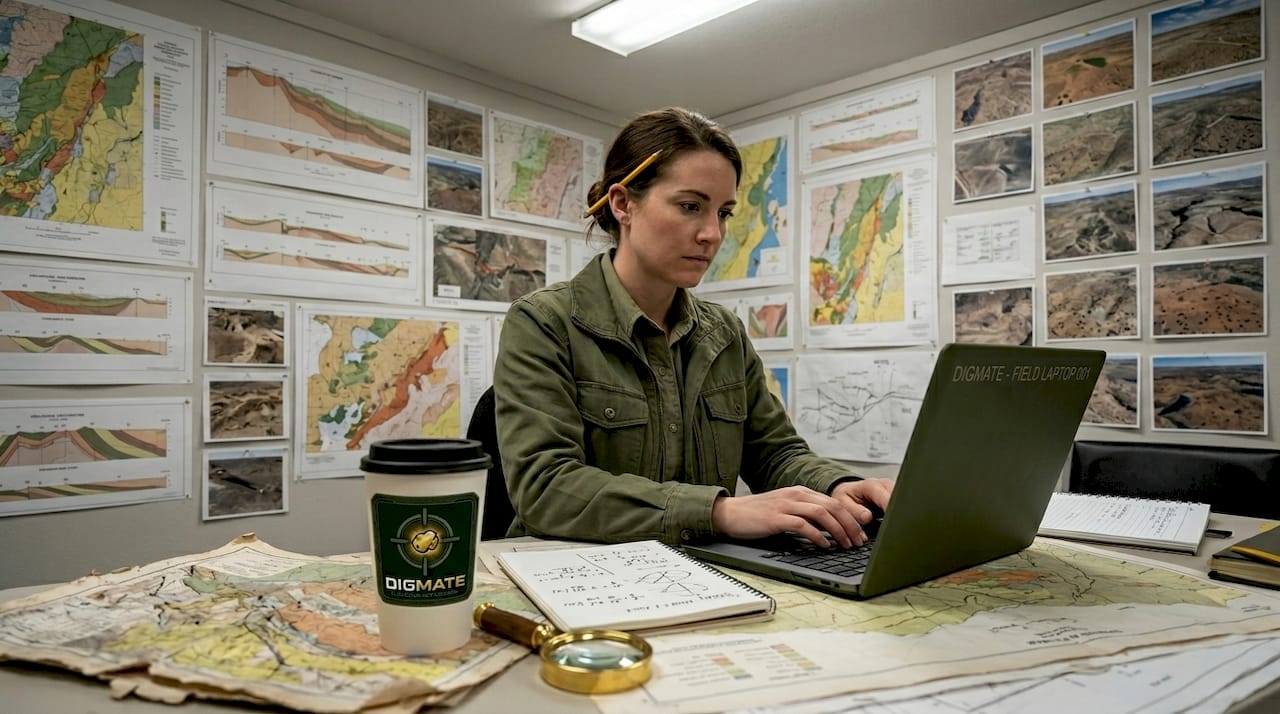
- Target generation: Compile historical data, geological maps, and satellite imagery to define areas of interest
- Baseline surveys: Conduct initial geophysical and geochemical work to rank targets
- First-pass drilling: Drill a small number of widely spaced holes to test primary targets
- Step-out drilling: If results are positive, expand the drill program to define the extent of mineralization
- Resource estimation: Apply geostatistical methods under JORC Code guidelines to calculate inferred, indicated, or measured resources
- Scoping and feasibility studies: Model the economics of potential extraction at different resource scenarios
The JORC Code (Joint Ore Reserves Committee Code) is the Australian and international standard for transparent, credible reporting of mineral resources and ore reserves. Resources are classified by data confidence: inferred (lowest confidence), indicated (moderate), and measured (highest). Competent persons, qualified geologists or engineers with relevant experience, sign off on all public reporting. This framework protects investors and ensures resource estimates are grounded in real, reproducible data rather than speculation.
| JORC classification | Data confidence | Typical drill spacing | Investment readiness |
|---|---|---|---|
| Inferred | Low | Wide | Early-stage only |
| Indicated | Moderate | Closer | Prefeasibility viable |
| Measured | High | Tight | Bankable feasibility ready |
The role of technology in this process is expanding rapidly. The importance of geodata to modern exploration programs cannot be overstated. Geospatial platforms now allow teams to overlay lithological maps, structural interpretations, and historical drill data at a level of resolution that would have required weeks of manual drafting a generation ago. And AI prospecting tools are beginning to identify mineralizing patterns in large datasets that human analysts routinely miss.
Pro Tip: If you are evaluating an exploration company, look for programs where the target generation methodology is clearly documented. Companies that can explain why they are drilling a specific hole, referencing specific geological controls, are operating at a materially different standard from those chasing surface anomalies without a coherent geological model.
Explorers vs producers: Key differences and risks
The distinction between an exploration company and a mining producer is more than a matter of size. They are fundamentally different businesses with different goals, different cash flow profiles, and very different relationships with risk.
"Explorers are in the business of creating value through discovery. Producers are in the business of extracting that value. Both are necessary. Neither replaces the other."
Explorers bear high risk and uncertainty with no revenue, operating through staged programs designed to de-risk projects for eventual sale or IPO. Producers, by contrast, operate established mines with defined resources, predictable costs, and revenue streams that fund ongoing operations.
| Feature | Exploration company | Mining producer |
|---|---|---|
| Primary goal | Discover and define deposits | Extract and process minerals |
| Revenue | None (pre-production) | Continuous from sales |
| Risk level | Very high | Moderate (operational) |
| Funding model | Equity raises, grants | Operating cash flow, debt |
| Exit options | Sale, JV, IPO, merger | Ongoing production |
| Team profile | Geologists and technicians | Engineers and operators |
The typical outcome for a junior exploration company is not to build a mine. Most juniors aim to advance a project to a point where its value is de-risked enough to attract a major producer or strategic investor. The exit pathways include outright sale of the project or company, joint venture agreements where a producer earns in by spending on exploration, and in some cases, an ASX listing that raises equity to continue exploration.
Some integrated companies manage both exploration and production, but this model is far less common than the clean separation between pure explorers and dedicated producers. For smarter prospecting tips that reflect both operational styles, it helps to understand which stage a project occupies before applying any evaluation framework.
The key contributions of exploration companies to the broader mining ecosystem include:
- Generating new mineral inventory to replace depleting mines
- Taking on first-mover risk that larger companies avoid
- Advancing geological knowledge of underexplored regions
- Creating optionality for producers by maintaining a pipeline of projects
- Driving regional economic activity in remote and rural communities
The explorer's role as the industry's innovation engine is often underappreciated. Because their survival depends on finding something nobody else has found, exploration companies are often the first adopters of new survey techniques, new geological frameworks, and new analytical platforms.
Why juniors matter: The pipeline for Australia's mining future
Australia's mining sector depends on a continuous flow of new mineral discoveries. Without exploration feeding new resources into the system, the mines operating today will eventually exhaust their reserves and close. That pipeline flows predominantly from junior exploration companies.
70 to 80 percent. That is the share of new greenfield mineral discoveries globally that are attributed to junior exploration companies. Junior explorers generate the majority of new discoveries worldwide, despite the reality that most individual projects fail and most juniors never transition to production. They are the search engine of the global mining industry, running countless parallel experiments across vast geographies.
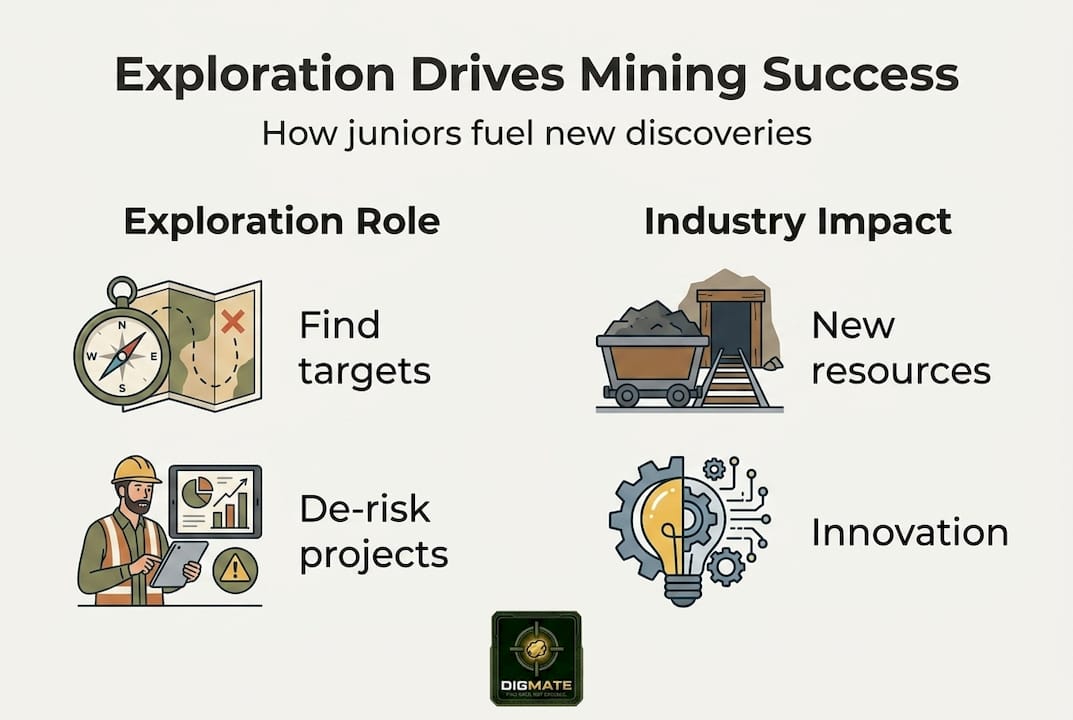
This is what makes the current funding environment so consequential. Juniors rely on equity and debt financing because they have no operating revenue. When equity markets are supportive, exploration activity flourishes. When investor sentiment turns risk-averse, exploration slows down and the future pipeline of minable deposits thins out. The lag between reduced exploration and reduced production can be a decade or more, making today's funding conditions a leading indicator for tomorrow's resource supply.
Three ways that junior explorers sustain the strength of Australia's mining industry:
- Replenishing reserves: Majors acquire juniors' discoveries to replace ore being depleted from their operating mines, keeping production stable and export revenues growing
- Expanding the geological frontier: Juniors explore areas that majors consider too early-stage or too geologically uncertain, pushing knowledge into new regions and deposit types
- Driving policy relevance: The junior sector's exploration expenditure data directly informs government policy on land access, royalties, and incentives like the Junior Minerals Exploration Incentive scheme
The Junior Minerals Exploration Incentive (JMEI) is a federal program in Australia that allows eligible exploration companies to convert tax losses into tax offsets that can be distributed to early-stage investors. This mechanism directly addresses the funding challenge by making investment in exploration more attractive. It acknowledges what the market sometimes forgets: without juniors taking on early risk, there is no pipeline.
Pro Tip: If you are an exploration company executive reviewing your data strategy, consider what AI-powered prospecting efficiency tools can do to accelerate your target ranking process. Reducing the time from license grant to drill decision is one of the most controllable variables in a junior's cost structure.
The companies that navigate this environment successfully tend to share certain traits: tight overhead structures, technically strong management, access to a network of sophisticated investors, and a disciplined approach to prioritizing targets based on data rather than enthusiasm.
What most mining guides miss about exploration companies
Most discussions of exploration in the industry press focus on discovery announcements and drill results. What they rarely address is the statistical reality underneath those headlines: the overwhelming majority of exploration programs produce no discovery. And that is fine. The economics of the sector are built on the assumption that one significant discovery will pay back many failed programs. But this reality creates a specific kind of organizational challenge that too few exploration companies plan for deliberately.
Resilience is not a soft skill in exploration. It is a core operational requirement. Companies that treat every failed drill hole as an intelligence signal, rather than a setback, build geological models that genuinely improve over time. Those that abandon methodology when results disappoint tend to cycle through targets randomly, burning capital without accumulating knowledge.
The other thing conventional guides miss is the pace of change in the tools available to explorers. A decade ago, integrating AI-driven pattern recognition into a target generation workflow was a research exercise. Today it is a practical option accessible to companies of any size. The better site selection strategies that are now available through geospatial platforms and AI-driven analytics are changing what it means to be a well-resourced explorer.
The industry myth that size or legacy equals innovation is particularly worth challenging. Some of the most technically sophisticated exploration programs in Australia right now are being run by small teams using modern data platforms, not by the largest companies with the deepest archives. Agility and data fluency matter more than institutional legacy when it comes to generating the next discovery.
The long-term winners in exploration will not simply be the companies that find the most deposits. They will be the ones that build repeatable, data-driven systems for finding deposits, and then have the discipline to follow those systems even when individual programs fail. That is where the real competitive edge is being built.
Take your exploration further with innovative prospecting tools
For prospectors and exploration professionals working across New South Wales and Victoria, having the right digital toolkit is no longer optional. It is a competitive baseline.

Digmate App brings AI-driven mineral detection, geospatial mapping, and real-time data analysis together in one platform purpose-built for Australian conditions. Whether you are running a solo prospecting program or coordinating exploration activity across multiple tenements, the platform's AI-powered prospecting features help you move from raw data to actionable site priorities faster than traditional methods allow. You can also access a free gold prospecting map to start identifying high-potential areas in your region with no upfront commitment. By integrating the kind of geospatial intelligence that once required a full GIS team, Digmate puts serious discovery capability within reach of every explorer.
Frequently asked questions
What are the main responsibilities of an exploration company in mining?
Exploration companies identify and define mineral deposits through geological surveys, sampling, and drilling before any mining begins, building the resource knowledge base that producers rely on.
How do exploration companies get funding for their projects?
Most exploration companies secure capital through equity raises or debt financing, with junior explorers particularly dependent on investors given that juniors rely on equity and debt funding due to their pre-revenue status and elevated discovery risk.
What is the JORC Code and why does it matter for explorers?
The JORC Code is the Australian standard for publicly reporting mineral resources, and explorers must report under JORC Code to give investors and partners reliable, independently verified resource data across inferred, indicated, and measured classifications.
Why do most exploration projects fail to become mines?
High geological uncertainty combined with funding constraints and strict regulatory requirements means that most projects fail to advance to production, even when initial results look promising, making rigorous target selection essential from the start.
What trends are shaping the future of exploration companies in Australia?
AI-driven analytics, tighter integration of geospatial data into target generation workflows, and ongoing federal support mechanisms like the Junior Minerals Exploration Incentive are all reshaping how exploration companies compete and discover in Australia's mineral-rich regions.