
TL;DR:
- Proper gear and legal permits are essential for efficient and responsible gold panning in NSW and Victoria.
- Locating gold-rich zones involves identifying natural traps, bedrock crevices, and specific river features.
- Advanced techniques and digital tools can significantly boost recovery rates and help build a sustainable prospecting approach.
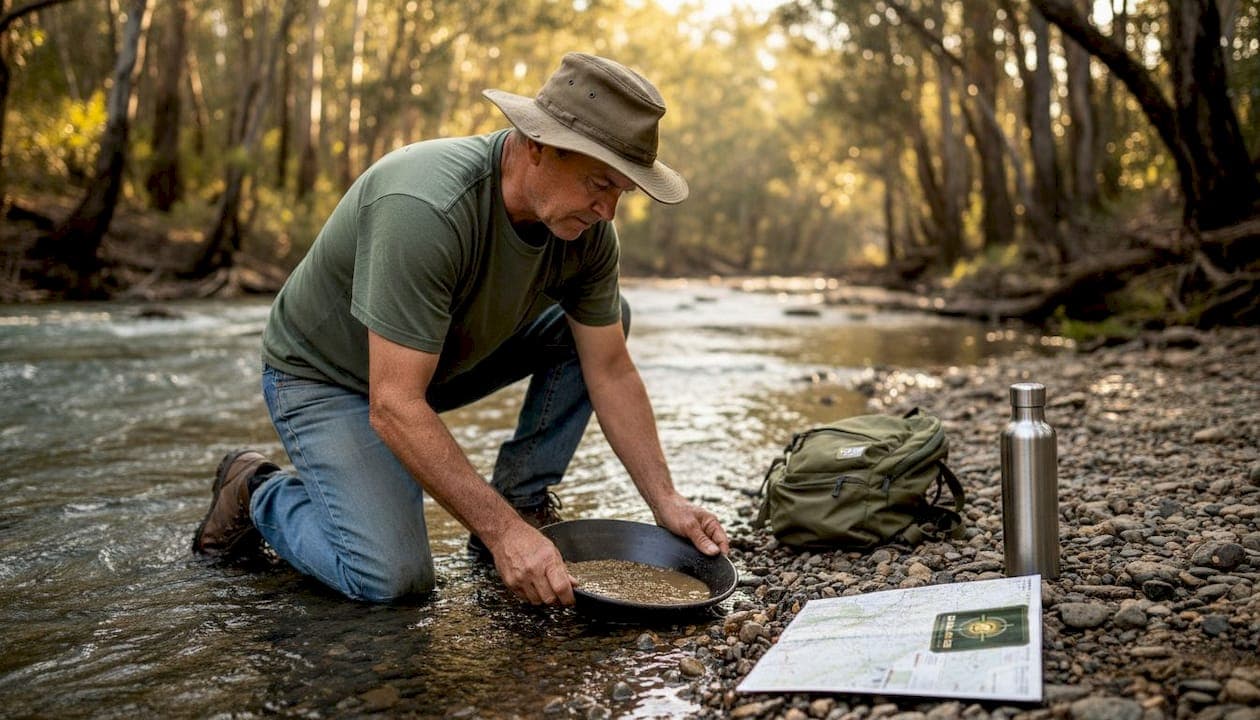
You spend three hours crouched over a creek in central Victoria, washing pan after pan, and walk away with barely a flicker of color. Sound familiar? Most hobbyist panners in New South Wales and Victoria hit this wall not because gold isn't there, but because small technique gaps and missed preparation steps quietly kill their yield. This guide covers everything you need: the right gear, current legal requirements, proven spot-selection strategies, a step-by-step panning method, and advanced efficiency tips that experienced panners use to consistently pull more gold from the same water everyone else walks past.
Table of Contents
- Essential tools and regulations for NSW and Victoria
- Finding the best spots to pan for gold
- How to pan for gold: Proven step-by-step techniques
- Boosting your efficiency: Advanced tips and common mistakes
- What most gold guides don't tell you: Hard-won lessons from the field
- Take your gold panning further with AI-powered prospecting
- Frequently asked questions
Key Takeaways
| Point | Details |
|---|---|
| Use modern panning tools | Modern riffled pans and sieves significantly boost your gold recovery rate. |
| Know your permits | Having the right fossicking license or Miner's Right is essential before panning. |
| Target proven spots | Insider bends, crevices, and historical sites in NSW and Victoria yield the best results. |
| Perfect your panning technique | Following a proven, step-by-step method maximizes your odds of finding gold. |
| Respect the environment | Use only hand tools, pack out waste, and avoid sensitive areas when prospecting. |
Essential tools and regulations for NSW and Victoria
Before you dig a single spade into a riverbank, you need two things sorted: your gear and your legal standing. Getting either wrong wastes time, money, and potentially lands you in trouble with authorities.
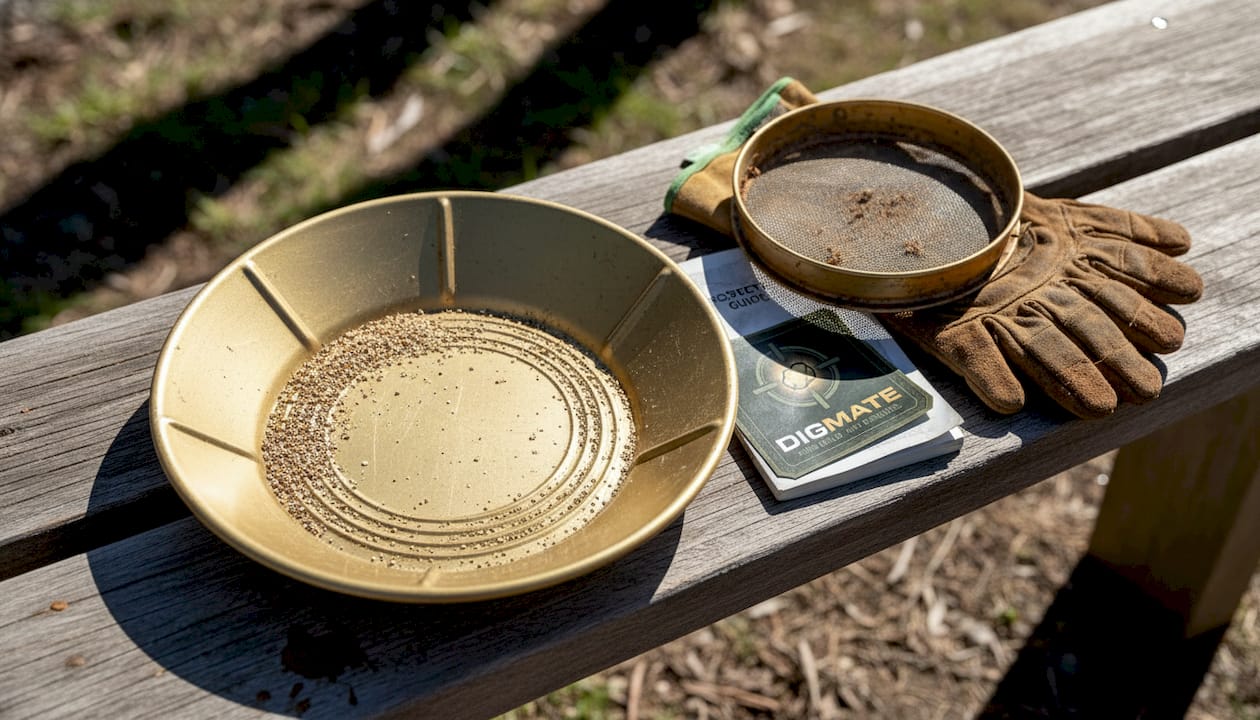
The core toolkit every panner needs:
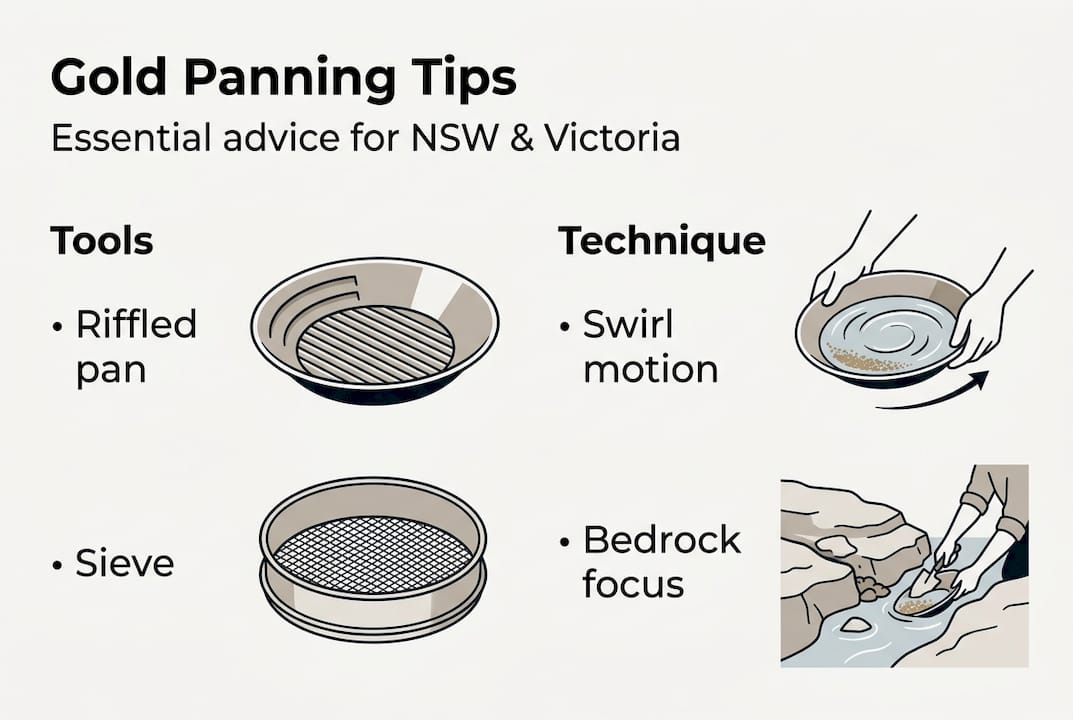
- Modern riffled pan (10 to 14 inch diameter)
- Classifier sieve (1/4 inch or finer mesh)
- Snuffer bottle for collecting fine gold
- Tweezers for picking out visible nuggets
- Small shovel or trowel
- Waterproof gloves and water-compatible footwear
- Sample vials or gold collection jars
- Optional: magnet for separating black sand (magnetite)
The riffled pan is non-negotiable. Those angled ridges trap heavy gold while lighter gravel washes over the edge. Everything else on the list supports that core function.
Legal requirements at a glance:
| Requirement | NSW | Victoria |
|---|---|---|
| Permit name | Fossicking license | Miner's Right |
| Cost | Free (designated districts) | $28.60 for 10 years |
| Valid for | Designated fossicking areas | Most Crown land |
| Tools allowed | Hand tools only | Hand tools, no machinery |
| Material limit | 10 kg mineral-bearing material/48 hrs | Per Miner's Right conditions |
Recreational fossicking in both states requires permits: the NSW fossicking regulations cover free licenses in designated districts with a 10 kg material limit per 48-hour period, while Victoria's Miner's Right costs just $28.60 and runs for ten years, covering hand tools and excluding any machinery. For a full breakdown of what you can and cannot do in Victoria, the Victoria fossicking license rules page covers current conditions in detail.
Environmental rules apply in both states. Stick to hand tools, fill in any holes you dig, and avoid disturbing vegetation or streambeds beyond what's necessary. These aren't just legal obligations. They protect the spots you'll want to return to.
Pro Tip: Always carry a printed or digital copy of your permit on-site. Rangers do check, especially in high-traffic goldfield areas.
For broader field conduct, the NSW and Victoria best practices guide outlines what responsible prospecting looks like in practice.
Finding the best spots to pan for gold
Once you're legal and geared up, location is everything. Gold doesn't distribute evenly across a riverbed. It concentrates in specific physical zones based on water flow, density, and bedrock structure.
Top gold panning regions by state:
| State | Prime Locations | Why They Work |
|---|---|---|
| NSW | Hill End, Turon River, Macquarie River, Gulgong, Ophir | Historic goldfield alluvials, consistent color in river gravels |
| Victoria | Golden Triangle (Bendigo, Ballarat, Maryborough), Castlemaine Diggings, Sovereign Hill | Dense historical deposits, exposed reef gold, well-documented pay zones |
These aren't random picks. Prime panning locations like Hill End in NSW and the Golden Triangle in Victoria have produced gold continuously since the 1850s rushes. The same geological forces that concentrated gold then still apply now, since erosion keeps feeding alluvial material downstream.
For broader coverage of the region, Albury-Wodonga gold spots and the top 5 Albury gold areas are worth bookmarking if you're working the border zone.
Physical clues that signal gold-rich zones:
- Inside river bends where current slows and heavies drop out
- Behind large boulders in natural low-pressure pockets
- Exposed bedrock surfaces and crevices where gold gets trapped
- Patches of moss or dense aquatic growth anchored to rock
- Color change zones where clay meets gravel (false bottoms)
- Deep gravel bars at the base of waterfalls or rapid sections
Bedrock is your best friend. Gold sinks until it hits something it can't pass through. That's why crevices in exposed bedrock consistently outperform open gravel beds. A thin screwdriver or crevice tool to clean those gaps can return more gold per minute than an hour of open-water panning.
For a detailed map of locations around Victoria, where to pan in Victoria is a practical starting point for planning your next trip.
How to pan for gold: Proven step-by-step techniques
Knowing where to dig is half the battle. Knowing exactly how to process your material is what determines how much gold you actually keep.
The complete panning sequence:
- Dig your sample from the target zone, ideally from within 6 inches of bedrock or from inside a natural trap
- Fill your pan roughly two-thirds full with gravel, removing any obviously large rocks by hand
- Submerge the pan and shake it firmly side to side to settle the heavies (gold included) toward the bottom
- Remove large rocks by hand while submerged, checking each one briefly for attached gold
- Swirl and tilt the pan at a shallow angle, letting water carry lighter material over the edge in controlled waves
- Repeat the swirl until only dark black sand and fine material remain
- Final rinse with a gentle swirl to reveal any visible gold flakes or colors against the pan's bottom ridges
- Collect your gold using a snuffer bottle for fine flakes and tweezers for larger pieces
The classifier sieve saves more gold than most panners realize. Running raw gravel through a 1/4 inch mesh before panning removes large waste material that would otherwise slow your wash and bury fine gold deeper in the pan.
Gold panning technique works by exploiting density differences. Gold is roughly 19 times denser than water and about 6 times denser than most river gravel. Controlled shaking and swirling use that density gap to separate what you want from what you don't. Rushed technique breaks that separation and gold escapes over the rim.
For detailed step instructions with visual reference, practice the motion in a plastic tub at home before hitting the field. Muscle memory matters here.
Pro Tip: If you're also looking for gems alongside gold, the gem prospecting tips guide covers dual-purpose fieldwork in NSW and Victoria.
Boosting your efficiency: Advanced tips and common mistakes
With the basics solid, a few targeted upgrades to your process can dramatically change your results without spending more time in the field.
Efficiency-boosting strategies:
- Add one drop of dish detergent to your pan water to break surface tension and help fine gold settle faster
- Use modern riffled pans which deliver 30% better fine gold recovery compared to traditional smooth-bottomed pans
- Sample at least 10 pans per location before committing to a sluice setup
- Watch for black sand concentrations. High magnetite zones often indicate you're in a genuine pay streak
- Work upstream from where you find your first color to track the source
- Keep a field notebook. Record GPS coordinates, depth, gravel type, and yield per session
Common mistakes that cost you gold:
- Panning too quickly, which washes fine gold over the rim before it settles
- Ignoring clay layers, which can trap gold flakes and fool you into thinking a spot is barren
- Failing to clean bedrock crevices properly before sampling the surrounding gravel
- Stopping after one or two negative pans in a spot that shows geological promise
- Skipping the classifier sieve to save time, which actually slows your net recovery rate
For panners who want to scale up, understanding when to use a metal detector alongside your pan can open up targets that water-based methods miss entirely. Shallow buried nuggets on terraced riverbanks are a classic example.
You can also use DigMate's ground scan features to cross-reference field geology before you commit a full day to a location. An
is worth watching if you want to see proper swirl technique demonstrated in real-time.What most gold guides don't tell you: Hard-won lessons from the field
Here's something most beginner guides skip over: gold panning is genuinely difficult to profit from on volume alone without sluicing or additional processing gear. Panning as a hobby delivers specks regularly for skilled panners, but low yield is the norm without moving significant material. That's not a reason to quit. It's a reason to reframe the goal.
The panners who consistently find gold aren't the ones with the best equipment. They're the ones who keep detailed records, revisit productive spots after flood events, and understand how gold moves through a river system over seasons. Reading geology is a skill you build over years, not weeks.
Environmental respect also pays in practical ways. Areas where panners leave a clean site stay open. Goldfields that develop a reputation for damage get restricted fast. The long-term access to your favorite creek depends directly on how you treat it today.
Digital tools change the game more than most field guides acknowledge. Tracking your finds, mapping your zones, and comparing geological layers across visits turns random luck into repeatable results. Review best practices for consistent finds to see how a structured approach separates casual hobbyists from panners who actually build their knowledge base over time.
Take your gold panning further with AI-powered prospecting
You now have a solid framework for finding, processing, and improving your gold panning results across NSW and Victoria. The next step is putting smarter data behind your field decisions.

DigMate is built specifically for prospectors in these two states, combining AI-driven mineral detection, geospatial mapping, and real-time site analysis so you can spend less time guessing and more time recovering gold. Whether you're planning your next trip or analyzing past finds, the DigMate gold prospecting tool gives you a digital edge that traditional guides can't match. Explore the full range of AI gold features or start with the free gold maps to identify high-potential zones before you even leave home.
Frequently asked questions
Do I need a permit for gold panning in New South Wales or Victoria?
Yes. NSW and Victoria both require permits for recreational gold panning: NSW issues a free fossicking license for designated districts, while Victoria requires a Miner's Right costing $28.60 for a 10-year term.
What is the best time of year to pan for gold in southeastern Australia?
Spring and early autumn offer the best conditions when water levels are lower and access is safer. River conditions and breeding seasons in sensitive riparian areas should always factor into your timing.
Which tools make the biggest difference for gold recovery?
Modern riffled pans and classifier sieves have the biggest impact. Modern pans deliver 75 to 80% efficiency compared to 50 to 60% for traditional smooth pans, making them a clear upgrade for any serious hobbyist.
How much gold can I keep from panning in a single trip?
NSW limits you to 50g of gold per person per 48 hours, with separate rules for nuggets over 10g. Victoria operates under Miner's Right conditions without an explicit gold weight limit, but land access and disturbance rules still apply.