
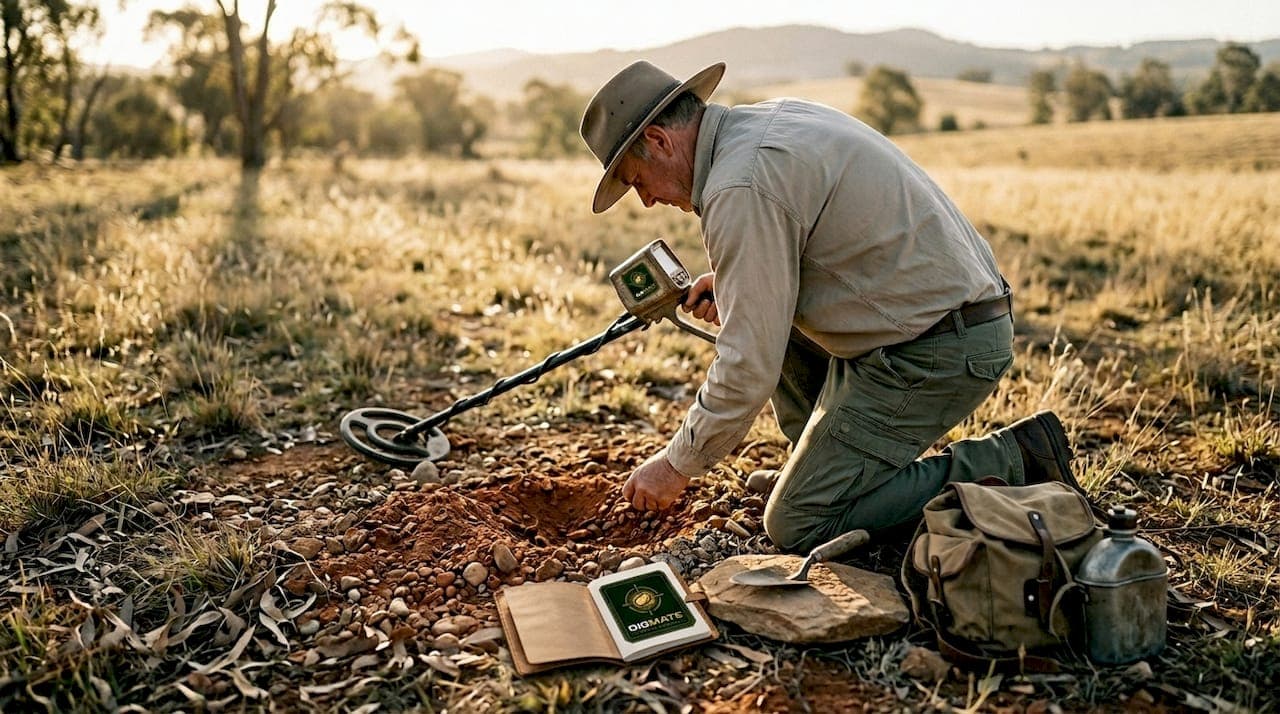
TL;DR:
- Australian goldfields require specialized techniques due to high mineralization and complex soil conditions.
- Legal permits and site-specific knowledge are essential to avoid fines and protect access rights.
- Mastering ground balance and using appropriate coils are key to successful mineralized goldfield prospecting.
Most people assume any metal detector will work anywhere you point it. That assumption has cost more than a few prospectors a wasted weekend in the Victorian goldfields or the ranges of New South Wales. The reality is that Australian goldfields are among the most mineralized ground on the planet, and without the right technique, legal knowledge, and field strategy, even an expensive detector will scream false signals all day. This guide cuts through the noise and gives you the practical framework you need to find real gold, stay legal, and make every outing count across NSW and VIC.
Table of Contents
- What is metal detector prospecting?
- Legal requirements and regulations in NSW and Victoria
- Advanced techniques for success in mineralized goldfields
- Field etiquette, safety, and maximizing the experience
- Why mastering the fundamentals beats chasing new tech
- Level up your next prospecting adventure
- Frequently asked questions
Key Takeaways
| Point | Details |
|---|---|
| Know the legal rules | A permit is required for detector prospecting and rules on land access are strictly enforced. |
| Adapt your technique | Ground balancing, coil choice, and sweep methods are vital for consistent finds in mineralized areas. |
| Respect the goldfields | Responsible practices like filling holes enhance sustainability and preserve site access. |
| Focus on fundamentals | Skill and local knowledge often outperform expensive new gear for goldfield success. |
What is metal detector prospecting?
Metal detector prospecting is the practice of using a specialized electronic detector to locate buried metallic targets, most commonly natural gold nuggets, old coins, and historical relics. Unlike traditional gold panning, which relies on water and gravity to separate surface alluvial gold, detector prospecting targets metals buried anywhere from a few centimeters to half a meter underground. The two approaches are fundamentally different. Panning reads what the creek gives you. Detecting lets you go looking.
The detectors used for serious goldfield work are not the toy units you find at beach shops. Purpose-built gold detectors operate at higher frequencies and use pulse induction or very low frequency technology to cut through soil interference. Ground mineralization, which is the concentration of iron oxides and conductive minerals in the soil, is the single biggest challenge in Australian goldfields. It creates constant background noise that masks real targets. Managing that noise is the core skill every prospector needs to develop.
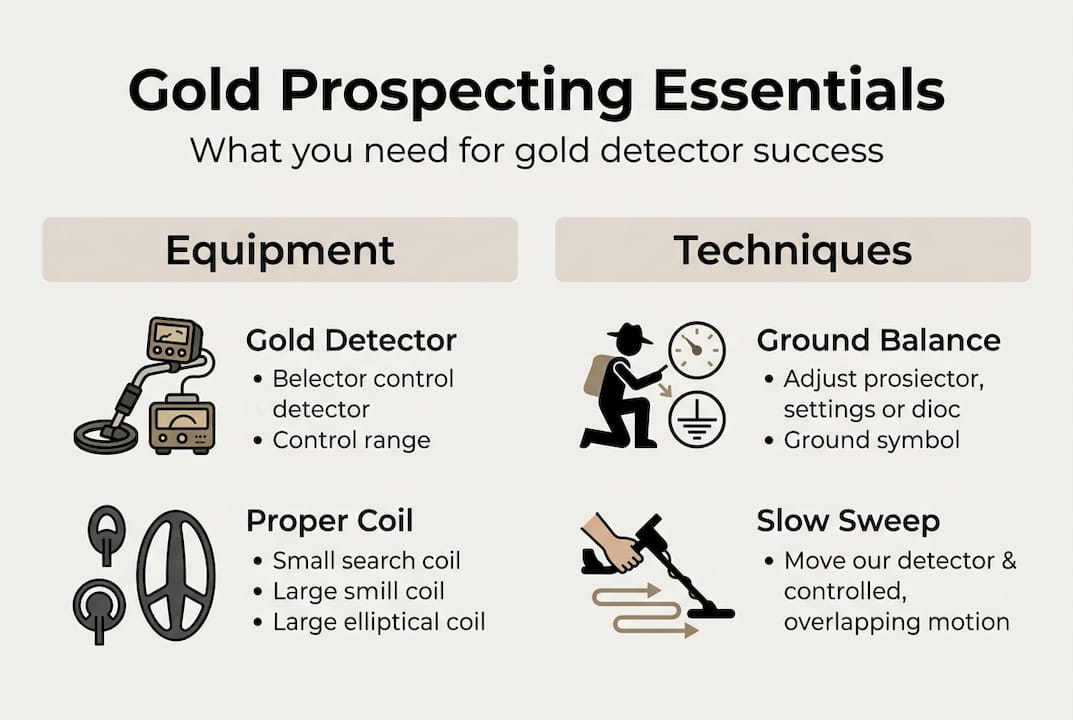
NSW and VIC offer some of the richest and most historically productive goldfields in the world. The central Victorian goldfields around Bendigo, Castlemaine, and Ballarat produced enormous wealth during the 1850s gold rush. NSW regions including Hill End, Sofala, and the New England area are equally storied. These areas still hold gold, but they also hold over 150 years of digging history, meaning the easy surface finds are long gone. Success today demands depth, precision, and smart site selection in NSW and Victoria.
Here is what you will typically need in the field:
- A purpose-built gold detector (VLF or pulse induction)
- Multiple coil sizes for different ground conditions
- A quality pinpointer for precise target location
- Digging tools that minimize ground disturbance
- Topographic maps and GPS for navigation
- Permits and licenses relevant to your state
"Modern metal detectors have transformed what prospectors can find, but the fundamentals of reading ground, understanding geology, and respecting the land remain as important as ever. Technology assists the skilled prospector; it does not replace them." Adapted from NSW fossicking guidance
The goldfields of NSW and VIC are not uniform. Some areas have heavily oxidized red soil, others have clay-heavy ground that shifts detector response dramatically. Learning to read the land before you even switch on your detector is what separates productive prospectors from frustrated ones.
Legal requirements and regulations in NSW and Victoria
Prospecting without the right paperwork is not just risky, it can result in fines and equipment confiscation. Both states have clear frameworks, and understanding them before you head out is non-negotiable.
In Victoria, a Miner's Right costs $28.60 for a ten-year period and is the baseline requirement to prospect on public land. It covers you for recreational prospecting with a metal detector, a gold pan, or a sluice on designated Crown land. The Miner's Right does not give you unlimited access. Certain rivers, parks, and reserves remain off limits regardless of what you hold.
In NSW, the fossicking license system operates differently. You need a fossicking license to prospect on designated fossicking lands and some traveling stock routes. Private land always requires written permission from the landholder, regardless of which state you are in.
| Requirement | Victoria | New South Wales |
|---|---|---|
| Permit name | Miner's Right | Fossicking license |
| Cost | $28.60 for 10 years | Varies by category |
| Public land access | Designated Crown land | Designated fossicking areas |
| Private land | Written consent needed | Written consent needed |
| Restricted zones | National parks, some rivers | National parks, state forests (some) |
Knowing where you legally stand on legal site selection is as important as knowing how to swing a coil. Prohibited areas include national parks, certain river corridors in Victoria, and all private land without explicit owner consent.
Key compliance practices every detector user must follow:
- Fill every hole you dig, restoring the surface as closely as possible
- Do not use mechanized equipment (such as a tractor or excavator) without additional permits
- Avoid disturbing vegetation beyond what is necessary for the dig
- Report any significant historical or cultural finds to the relevant authority
- Never prospect within declared Aboriginal heritage sites
Pro Tip: Before any trip, cross-check your planned location against the current interactive maps on the Victorian Department of Energy, Mines, Industry Regulation and Safety website and the NSW Resources Regulator portal. Boundaries shift, and an outdated paper map can put you on the wrong side of the law.
Advanced techniques for success in mineralized goldfields
Once your permits are sorted, the real work begins. Australian goldfields will punish a poorly set-up detector. Here is how to get the most out of your machine in challenging ground.
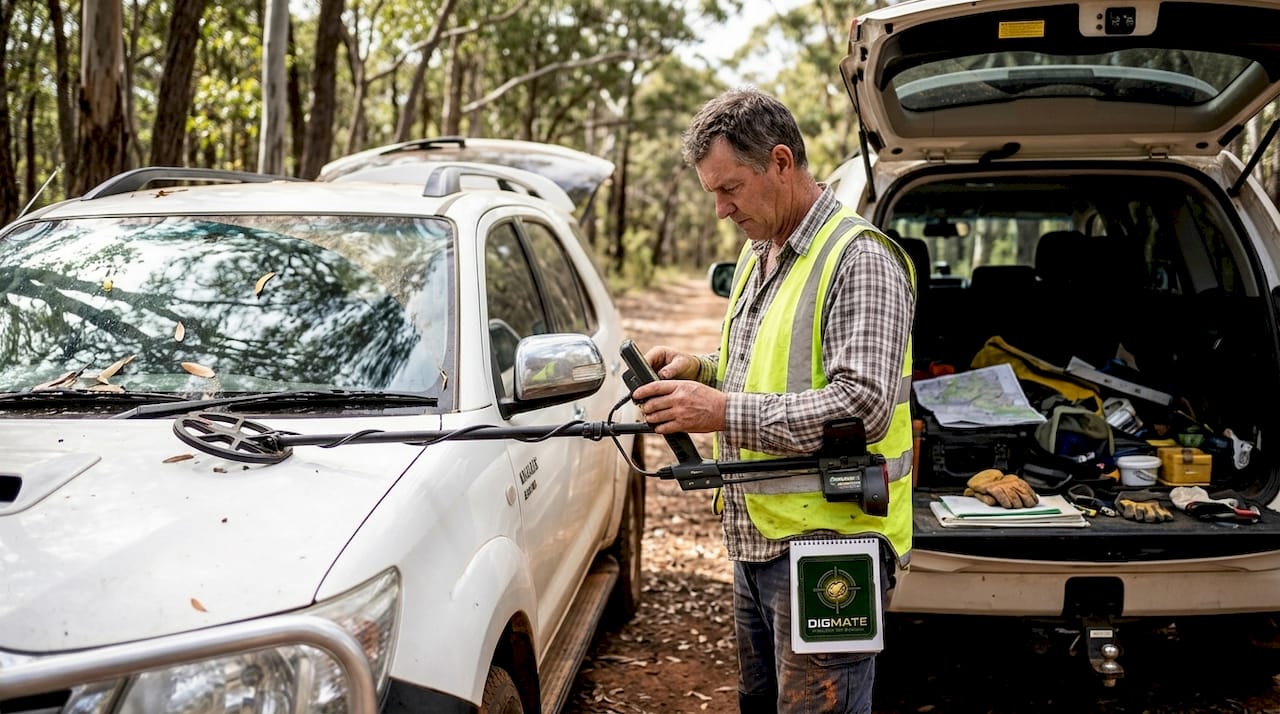
Ground balancing is the single most important setting on any gold detector. It tells the machine to ignore the background mineralization signal so it can focus on actual targets. Most modern detectors offer both manual and automatic ground balance. Manual ground balance gives you finer control in complex, heavily mineralized soils, which is exactly what you face across most Victorian and NSW goldfields. Auto balance is a reasonable starting point for beginners but tends to miss subtle targets in variable ground.
Hot rocks are a constant frustration. These are individual rocks with a higher mineral concentration than the surrounding soil, and they trigger a response that sounds identical to a small gold target. The fix is to learn the specific tone your detector produces for hot rocks versus gold, and to recalibrate your ground balance whenever you move to a new patch of ground.
| Coil type | Best use case | Ground condition |
|---|---|---|
| DD (double-D) coil | Depth and stability | Heavily mineralized soil |
| Mono coil | Maximum depth on clean ground | Low to moderate mineralization |
| Small coil (under 10") | Tight spaces, trashy ground | Rocky areas, old diggings |
| Large coil (14"+ ) | Wide coverage, deep targets | Open paddocks, low trash |
Using AI prospecting tools alongside your detector setup can help you predict which coil type suits a specific location based on geological data before you even arrive on site. The importance of geodata in planning your coil and sensitivity settings cannot be overstated.
Step-by-step setup for mineralized goldfields:
- Pump the coil close to the ground three to four times to sample the local mineralization level
- Set your ground balance manually using the pump technique until the threshold tone is stable
- Lower your sensitivity just below the point where the detector becomes erratic
- Reduce your sweep speed to roughly one meter every two seconds
- Overlap each sweep by at least 50 percent to avoid gaps in coverage
- Recalibrate every time you move more than 20 meters in a new direction
Pro Tip: Overlap your sweeps by more than you think is necessary and recalibrate every time the background tone shifts. That shift tells you the ground has changed, and your previous settings are now working against you.
Field etiquette, safety, and maximizing the experience
Technique gets you targets. Behavior keeps the hobby alive.
Filling your holes is not optional. It is a legal requirement in both NSW and VIC, and it is the single most visible marker of whether a prospector respects the land. Unfilled holes damage pasture, create hazards for livestock, and give authorities a reason to restrict access for everyone. Best practice site rehabilitation means replacing the dirt in the same order it came out, tamping it down, and replacing any surface vegetation where possible.
Joining a local prospecting club is one of the smartest moves any detector user can make. Clubs like the Gold Prospectors Association of Australia and various state-based groups share private land access agreements, run training days, and maintain relationships with landholders that individual prospectors simply cannot replicate. The knowledge transfer alone, from experienced members who know specific goldfields intimately, is worth more than most gear upgrades.
"Responsible prospectors keep the hobby sustainable for all. Every hole you fill and every permit you carry is an investment in access for the next generation of prospectors."
Safety in the Australian bush is serious. Heat, dehydration, and snake encounters are real risks, particularly in the summer months. Before every trip, run through this essentials checklist:
- Valid permits and licenses for the state you are prospecting in
- Topographic map and GPS device with charged batteries
- First aid kit with a snake bite bandage
- Minimum three liters of water per person per day
- Sun protection including hat, sunscreen, and long sleeves
- Spare detector batteries and a charged mobile phone
- Emergency contact details left with someone at home
For local site research before any outing, cross-referencing historical goldfield maps with current access rules will save you time and keep you out of restricted zones.
Ethical handling of finds matters too. Significant historical relics may be subject to heritage protection laws. When in doubt, photograph the item in place, record the GPS coordinates, and contact the relevant state authority before removing anything that looks like it could be culturally or historically significant.
Why mastering the fundamentals beats chasing new tech
Here is an uncomfortable truth the gear industry does not want you to hear: most of the gold being found in NSW and VIC right now is being found by prospectors who have been swinging the same detector for five or more years, not by people who just bought the latest model.
The temptation to upgrade is real. A new detector with a better processor sounds like the answer when you are coming home empty-handed. But in most cases, the problem is not the machine. It is ground balance settings that are slightly off, sweep speed that is too fast, or coil selection that does not match the ground. Veterans routinely outperform newcomers with far more expensive equipment because they have learned to listen to what the detector is actually telling them.
AI tools for prospecting and digital platforms genuinely add value when it comes to site research, geological analysis, and legal compliance tracking. That is a real advantage. But those tools amplify skill; they do not replace it. A prospector who cannot manage ground balance will not suddenly find gold because they have better mapping software.
Pro Tip: Go back to a goldfield you have already worked with fresh settings and a different coil. You will often find targets you walked right over the first time.
Level up your next prospecting adventure
You now have the framework: the right technique, the legal knowledge, and the field habits that make the difference between a productive outing and a frustrating one. The next step is putting it all together efficiently.

The DIGMATE app is built specifically for prospectors working across NSW and Victoria. It combines AI-driven site analysis, real-time mapping of legal access zones, and field data recording so you can track what settings worked where and why. Instead of relying on memory or scattered notes, you get a digital prospecting companion that helps you research sites before you leave home, stay compliant with current permit rules, and build a personal database of productive locations. It is the practical bridge between the techniques in this guide and consistent results in the field.
Frequently asked questions
Do I need a license to metal detect for gold in Victoria?
Yes, you must purchase a Miner's Right, which costs $28.60 for ten years and is required to prospect legally on public land in Victoria.
Where is metal detector prospecting not allowed in NSW or Victoria?
Prospecting is banned in national parks, some rivers in Victoria, and all private land without owner consent in both states.
What is the best metal detector coil for mineralized goldfields?
In mineralized ground, DD coils offer greater stability and depth, while small coils excel in trashy or rocky areas where precision matters more than coverage.
Is it better to use manual or automatic ground balance when prospecting?
Manual ground balance is preferred for complex goldfields, but auto works for beginners. Always recalibrate when ground conditions change.
How can I maximize safety and ethics when out prospecting?
Always fill your holes, restore the site, carry your permits, join a local club, and follow all current state prospecting laws for the area you are working in.