
TL;DR:
- Differentiating mineral resources from ore reserves is crucial for accurate reporting and project planning.
- Proper use of JORC terminology and environmental terms ensures regulatory compliance and credibility.
- Accurate field documentation and terminology enhance investment attraction and sustainable exploration practices.
Confusing a Mineral Resource with an Ore Reserve is one of the most costly mistakes a prospector can make, yet it happens constantly in the field and in reporting. These aren't interchangeable labels. They represent fundamentally different levels of geological confidence, economic assessment, and regulatory standing. Get them wrong and you risk wasting months of fieldwork, misrepresenting a project to potential partners, or running into compliance headaches you didn't see coming. This guide cuts through the jargon and gives you the practical vocabulary you need to work smarter across New South Wales and Victoria, whether you're documenting a new site or presenting findings to a joint venture partner.
Table of Contents
- Foundation of mining terminology: The JORC code explained
- Key terms every Australian prospector should know
- Environmental terminology: Remediation and sustainability
- Applying mining terminology: From field notes to public reporting
- Perspective: What most prospectors miss about mining terminology
- Enhance your exploration with DigMate's tools
- Frequently asked questions
Key Takeaways
| Point | Details |
|---|---|
| JORC framework importance | Mastering JORC terminology is vital for accurate reporting and exploration confidence in Australia. |
| Common terms demystified | Understanding key mining words prevents costly mistakes and improves communication with stakeholders. |
| Environmental compliance insights | Knowing remediation vocabulary helps ensure legal and sustainable site practices for prospectors. |
| Application boosts success | Applying terminology correctly in field notes and reports strengthens project credibility and outcomes. |
Foundation of mining terminology: The JORC code explained
The Joint Ore Reserves Committee (JORC) Code is the rulebook for mineral resource and ore reserve reporting across Australia. Every serious prospector, geologist, and mining company operating in Australia reports resource estimates within this framework. If you don't understand its core vocabulary, you're essentially reading a map without a legend.
The JORC Code draws a clear line between two categories that many prospectors blur together. A Mineral Resource is defined as a concentration or occurrence of material with reasonable prospects for eventual extraction, while an Ore Reserve is the economically mineable portion of a Measured or Indicated Resource. That distinction is enormous. A Mineral Resource says "this might be worth something." An Ore Reserve says "we've done the economic work, and yes, we can extract this profitably."
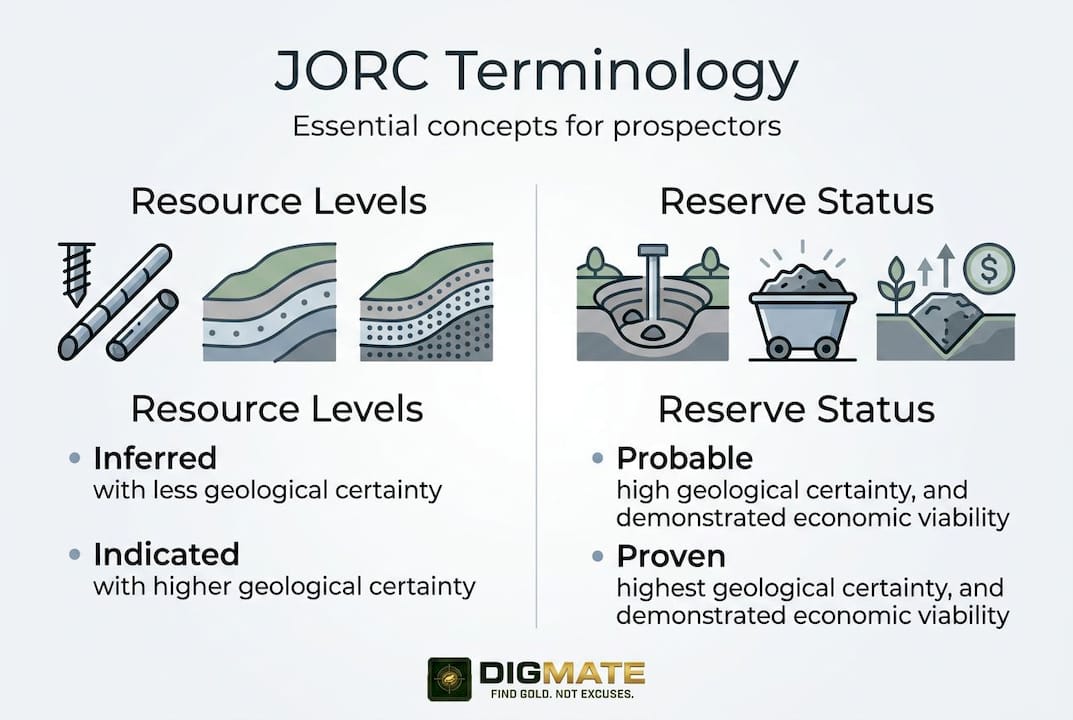
Within the Mineral Resource category, JORC uses three confidence sub-divisions:
- Inferred: Lowest confidence. Estimated from limited data with geological continuity implied, not verified. Cannot be directly converted to an Ore Reserve.
- Indicated: Moderate confidence. Enough data exists to make reasonable assumptions about grade, tonnage, and continuity.
- Measured: Highest confidence. Detailed, reliable data confirms grade, tonnage, and physical characteristics.
Ore Reserves also split into two categories:
- Probable Ore Reserve: Derived from an Indicated Resource, or sometimes a Measured Resource, where modifying factors have been applied but carry some residual uncertainty.
- Proved Ore Reserve: Derived from a Measured Resource with high confidence. The gold standard for economic mining reports.
One rule that trips up prospectors constantly: an Inferred Resource can never directly convert into an Ore Reserve. The leap requires upgrading confidence through additional drilling, sampling, and economic assessment first. Skipping this step doesn't just weaken a report. It violates the JORC framework outright.
| JORC Classification | Confidence Level | Can Convert to Reserve? |
|---|---|---|
| Inferred Resource | Low | No |
| Indicated Resource | Moderate | Yes (Probable) |
| Measured Resource | High | Yes (Proved or Probable) |
| Probable Reserve | Moderate | N/A |
| Proved Reserve | High | N/A |
Pro Tip: When reviewing or writing exploration reports, check which classification is being used before drawing conclusions about a site's potential. An "Inferred" label is a signal to keep drilling, not to start planning infrastructure. Using the right classification from the start also guides smarter decisions about where to focus your next round of exploration tips NSW & Victoria.
Understanding these distinctions isn't just about paperwork. It shapes how you allocate time, money, and equipment across a tenement. The difference between an Inferred and a Measured Resource can mean the difference between a speculative dig and a bankable project. Apply this framework in combination with solid prospecting best practices 2026 and you'll approach every site with far more precision. Pair that with accurate importance of geodata for your site and you're building a genuinely defensible case for any target zone.
Key terms every Australian prospector should know
Now that the primary framework is clear, let's build your vocabulary with essential terms. Technical language in mining isn't just formality. It's the shared shorthand that lets you communicate precisely with geologists, regulators, and project partners. Misuse a term in a field report or public statement and you can face regulatory scrutiny or lose credibility fast.
The JORC terminology represents the standardized, high-confidence framework essential for mineral exploration reporting in Australia, and understanding the boundary cases, particularly that Inferred resources cannot convert to Reserves, is what separates competent prospectors from experienced ones. But beyond JORC, there's a broader vocabulary you'll encounter constantly.
| Term | Definition | Field Application |
|---|---|---|
| Tailings | Processed ore residue after valuable minerals are extracted | Stored in a Tailings Storage Facility (TSF); can still contain trace metals |
| Waste Rock | Non-ore material removed during mining | Must be managed for acid-forming potential |
| TSF | Tailings Storage Facility | Site for storing fine-grained waste slurry |
| PAF | Potentially Acid Forming material | Requires isolation to prevent acid drainage |
| Capping | Covering contaminated material with inert material | Used in remediation to limit leaching |
| Tenement | A granted mining or exploration license area | The legal boundary of your right to prospect |
| Grade | Concentration of target mineral per unit volume | Higher grade = more valuable per tonne |
| Assay | Chemical analysis of a sample's mineral content | Core tool for quantifying resource potential |
Some of the most misunderstood terms by prospectors in the field include:
- Tailings vs. Waste Rock: Many people use these interchangeably. Tailings are fine-grained and wet, the byproduct of processing. Waste Rock is coarser, unprocessed, and removed during excavation. Each has different environmental and regulatory implications.
- Grade vs. Tenor: Grade is commonly used for the overall deposit. Tenor refers specifically to the metal content of a concentrate.
- Resource vs. Reserve: Covered in depth above, but still the single most common mix-up in amateur reporting.
- Tenement vs. Lease: A tenement is the overarching term for any mining title. A lease is a specific type of tenement that allows actual mineral extraction, not just exploration.
For practical gold prospecting NSW & Victoria, understanding assay results and how grade influences target prioritization is critical. A site showing high-grade samples within a small zone might be more economically interesting than a large low-grade system, depending on commodity price and depth. Knowing how geology's role in gold finding connects to these classifications helps you make that call faster and with better evidence. Combine proper vocabulary with smart prospecting site selection tools and your field reconnaissance becomes a whole lot more focused.

Environmental terminology: Remediation and sustainability
Beyond technical vocabulary, environmental terms matter for responsible mining. Regulators in New South Wales and Victoria expect prospectors and mining operators to demonstrate an understanding of environmental risk language. Getting this wrong isn't just embarrassing. It can lead to permit refusals, fines, or site shutdowns.
The core environmental terms in Australian mining revolve around how materials interact with water and oxygen once exposed. According to the Queensland government's remediation glossary, the key terms include:
- Acid and Metalliferous Drainage (AMD): Produced when sulphide minerals in waste rock or tailings oxidize on contact with water and air, creating acidic runoff that can carry heavy metals into waterways.
- Potentially Acid Forming (PAF) material: Any rock or tailings that has the chemical potential to generate acid when exposed. Identifying PAF material before you disturb a site is a legal and ethical requirement.
- Non-Acid Forming (NAF) material: Waste rock or tailings with insufficient sulphide content to generate acid. Generally considered benign for disposal purposes.
- Tailings Storage Facility (TSF): The engineered containment structure for fine-grained tailings. TSF failures (dam breaks) are one of the most serious environmental hazards in mining.
- Capping or Encapsulating: Placing a layer of inert material over contaminated waste to prevent water ingress and oxygen contact, limiting AMD generation.
"The difference between a compliant operation and a shutdown notice often comes down to whether the operator understood PAF material and planned for it before breaking ground, not after."
Remediation benchmarks add another layer of vocabulary. When a site requires remediation, engineers aim to reprofile tailings into stable landforms that resist erosion, divert surface water, and include seepage collection systems to capture any contaminated drainage before it reaches the environment. These aren't optional upgrades. They're regulatory benchmarks in most Australian states.
Common mistakes prospectors make in this area:
- Assuming old waste rock dumps are benign without testing for PAF potential
- Confusing AMD with simple acidic soil, which has a different cause and treatment
- Not accounting for the long-term stability of a TSF when assessing a historical site's risk profile
Pro Tip: Before working near any abandoned mine site in NSW or Victoria, check whether historical tailings have been tested for PAF potential. Old gold processing sites often used cyanide leaching, and the tailings may contain elevated arsenic, mercury, and other metals. Using AI prospecting tools that overlay historical site data with environmental risk layers can save you from unknowingly working a hazardous zone.
Applying mining terminology: From field notes to public reporting
With terminology and environmental jargon in hand, here's how to use these concepts in real prospecting scenarios and professional reporting. Knowing the words is one thing. Using them correctly in a workflow, from site observation to formal submission, is where they pay off.
Here's a practical step-by-step workflow for applying mining terminology correctly:
- Site observation and documentation: Record rock types, alteration zones, visible mineralization, and any signs of previous disturbance. Use precise geological terms (e.g., "gossan," "quartz vein," "arsenopyrite association") rather than general descriptions.
- Sample collection and assay submission: Label samples consistently, document GPS coordinates, and specify the sample type (chip, channel, grab). When results return, report in terms of grade (g/t for gold, % for base metals).
- Environmental screening: Identify any PAF materials on site, note proximity to watercourses, and document any visible AMD or seepage. Per remediation benchmarks, flag tailings reprofiling needs and seepage collection requirements if working near legacy sites.
- Resource classification (if applicable): Assess whether your data is sufficient to support an Inferred, Indicated, or Measured classification. Be conservative. Overclaiming resource confidence is a compliance risk.
- Report writing: Use JORC-compliant language for any public or formal reporting. Clearly state confidence levels, data limitations, and any modifying factors applied to resource estimates.
- Review and compliance check: Have a Competent Person (as defined by JORC) review any formal resource or reserve statements before release.
Misclassifying resources is not a minor error. Projects have lost investor confidence and regulatory approval because someone called an Inferred Resource a Reserve without the underlying data to support it. The practical rule is simple: when in doubt, use the lower confidence classification and flag the data gaps explicitly. This is also why gem prospecting strategies benefit from the same rigorous documentation approach. Whether you're chasing sapphires in central Queensland or gold reefs in Victoria, the vocabulary and workflow remain consistent.
A final note on field notes: they're legal documents in many regulatory contexts. Notes that use vague language like "looks mineralized" or "seems like waste" can undermine a project during compliance review. Precise, consistent terminology from the first day of fieldwork builds a credible record that holds up under scrutiny.
Perspective: What most prospectors miss about mining terminology
Most prospectors treat terminology as a formality, something you learn just enough of to fill out forms and move on. That's a significant strategic error. Terminology is the infrastructure of communication. When you use the wrong word in a resource report, you're not just being imprecise. You're potentially misrepresenting the economic value of an asset to anyone who reads it.
The Inferred Resource edge case is the clearest example. We see it repeatedly: a prospector does excellent fieldwork, finds genuinely exciting mineralization, and then labels it as a "resource" in casual communication or early-stage reports. A partner or investor reads that and assumes it's a Probable Reserve. Expectations get set that the data cannot support. The project stalls or collapses not because the geology was wrong but because the language was.
Proper vocabulary also opens doors. A well-documented, JORC-compliant report that correctly classifies resources, acknowledges environmental risk using terms like AMD and PAF, and follows the workflow from field note to formal submission signals professionalism. That signal attracts serious partners, investment, and regulatory goodwill. Poor terminology does the opposite. Apply exploration best practices consistently and your reports become assets, not liabilities.
Enhance your exploration with DigMate's tools
Ready to apply what you've learned? DigMate puts the right data directly in your hands so your terminology decisions are grounded in accurate, real-time field intelligence.

DigMate's AI prospecting features integrate geospatial mapping with mineral detection tools, helping you document sites with the precision that JORC-compliant reporting demands. Whether you need to identify rock types on the fly, screen for environmental risk layers, or zero in on the most promising zones in NSW or Victoria, DigMate streamlines every step of the workflow. Explore the rock identification tool to sharpen your field observations, or access the free gold map to start planning your next target with data-backed confidence.
Frequently asked questions
What is the difference between a Mineral Resource and an Ore Reserve?
A Mineral Resource is a concentration with reasonable prospects for extraction, while an Ore Reserve is the economically mineable portion, classified as Probable or Proved under higher confidence assessments and economic evaluation.
Why is it important to distinguish Inferred from Indicated resources?
Inferred resources cannot be directly upgraded to Ore Reserves and carry higher uncertainty, which impacts exploration risk, reporting credibility, and the economic case for advancing a project.
What does PAF material mean in mining?
PAF stands for Potentially Acid Forming material. Per the Queensland government's remediation glossary, it refers to rocks or tailings that generate acidic runoff when exposed to air and water, requiring isolation or capping to prevent environmental harm.
How do environmental terms affect mining compliance?
Terms like AMD, TSF, and capping define the remediation procedures required under Australian regulations, and using them correctly in site documentation is essential for legal compliance and responsible mineral exploration.