
TL;DR:
- Proper ground balance and small coils are essential for detecting gold in mineralized soils and trashy areas.
- Skilled sweeping technique and signal interpretation greatly improve gold detection success, regardless of equipment.
- Experience and technique surpass equipment quality, with digital tools like DigMate enhancing strategic prospecting.
Gold prospecting in New South Wales and Victoria demands more than a good detector and a willing attitude. The terrain shifts from heavily mineralized ironstone country to alluvial creek beds, and the gold itself ranges from fine flour particles to chunky nuggets sitting just below the surface. What separates consistent finders from frustrated wanderers is a combination of calibrated equipment, refined technique, and smart site strategy. This guide walks you through the expert-backed methods that give you a real edge, covering ground balance, coil selection, signal reading, detector choice, and field tactics that work across both states.
Table of Contents
- Master your ground balance and coil selection
- Perfect coil sweeping and signal interpretation
- Select the optimal detector: PI vs VLF explained
- Field strategies for gold-rich sites and overlooked targets
- Why detection skill beats equipment in gold prospecting
- Level up your prospecting with DigMate tools
- Frequently asked questions
Key Takeaways
| Point | Details |
|---|---|
| Optimize ground balance | Manual ground balancing and the right coil size dramatically improve results in tough soils. |
| Sweep methodically | Slow, overlapping sweeps and careful signal reading uncover more gold than quick passes. |
| Match detector to terrain | Choose PI detectors for depth and mineralization, or VLF for shallow, smaller gold targets. |
| Leverage site knowledge | Well-researched locations and advanced mapping apps boost your gold finding rate. |
Master your ground balance and coil selection
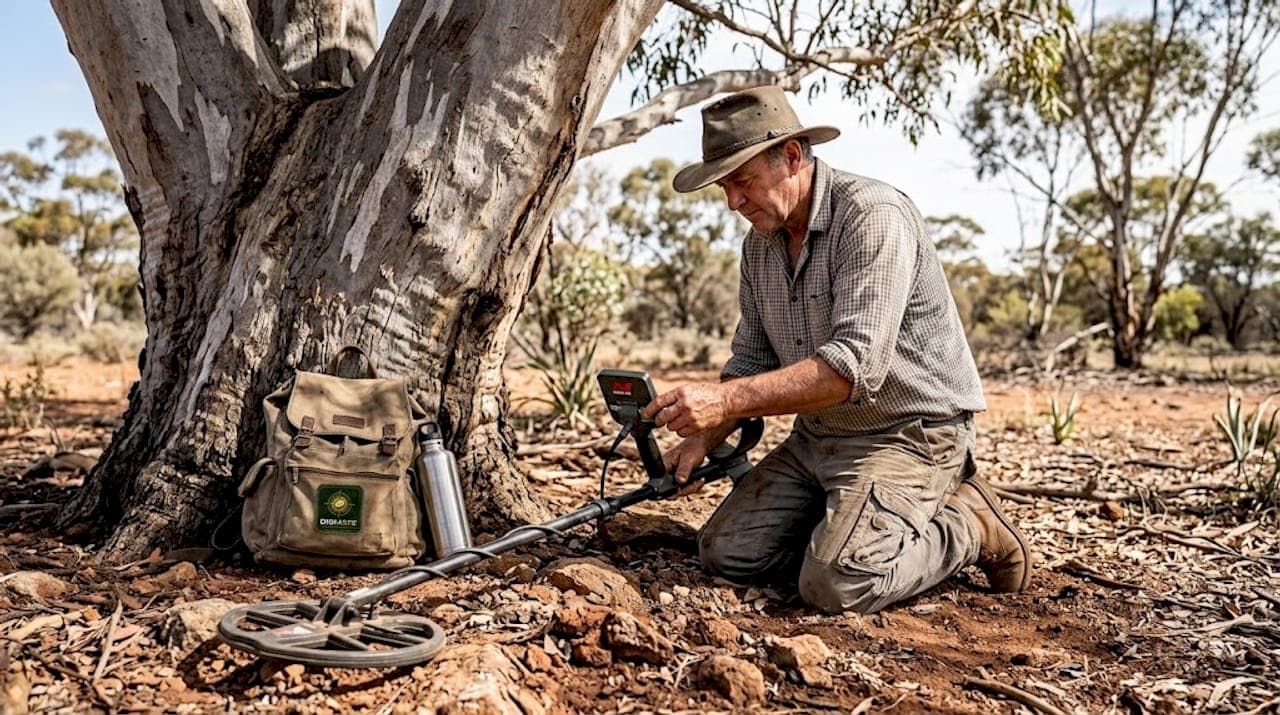
Every productive detecting session starts before you swing a coil. Getting your detector properly tuned to the ground beneath your feet is the single most important setup step, and it is one that many prospectors rush or skip entirely.
Victoria and NSW goldfields are notorious for highly mineralized soils. Red ironstone, black sand, and basalt-rich ground all create electromagnetic noise that masks genuine gold signals. When you rely on automatic ground balance in these conditions, your detector is constantly chasing a moving target. Manual ground balance lets you lock in a precise reading for the specific patch you are working, giving you a stable threshold and cleaner audio response.
Coil size is the other variable that changes everything. Larger coils cover more ground and reach deeper, but they also average out signals across a wider area. In trashy ground or previously worked patches, a large coil will often ignore small nuggets entirely because the surrounding junk overwhelms the response. Small coils (8-11 inches) for trashy or shallow worked areas detect small nuggets missed by larger coils, and manual ground balance in mineralized soils keeps your threshold stable enough to hear them.
Here is what to keep in mind when choosing your coil:
- Small coils (8-11 inches): Best for trashy areas, shallow gold, and tight creek beds
- Medium coils (11-14 inches): Versatile for general prospecting in moderate ground
- Large coils (15+ inches): Cover ground faster and reach deeper in clean, open terrain
- DD (double-D) coils: Handle mineralized ground better than concentric coils in most Victoria and NSW conditions
"Ground balance manually in mineralized soils; use small coils (8-11 inches) for trashy or shallow worked areas to detect small nuggets missed by larger coils." This approach is especially critical in the Central Victorian goldfields and the Lachlan Fold Belt in NSW, where soil mineralization can be extreme.
Pro Tip: Carry both a small and a standard coil in your kit. Swap to the small coil whenever you enter a known patch or worked area. You will be surprised how much gold the previous crew left behind.
For a deeper look at which machines perform best in these conditions, check out the best detectors for Australian goldfields. Understanding how to read prospecting terrain before you even set up your detector also pays dividends in the field.
Perfect coil sweeping and signal interpretation
Once your detector is optimized, your sweeping technique and signal reading can mean the difference between junk and gold. A well-tuned machine operated with poor technique will still miss targets that a skilled operator finds on the same patch.
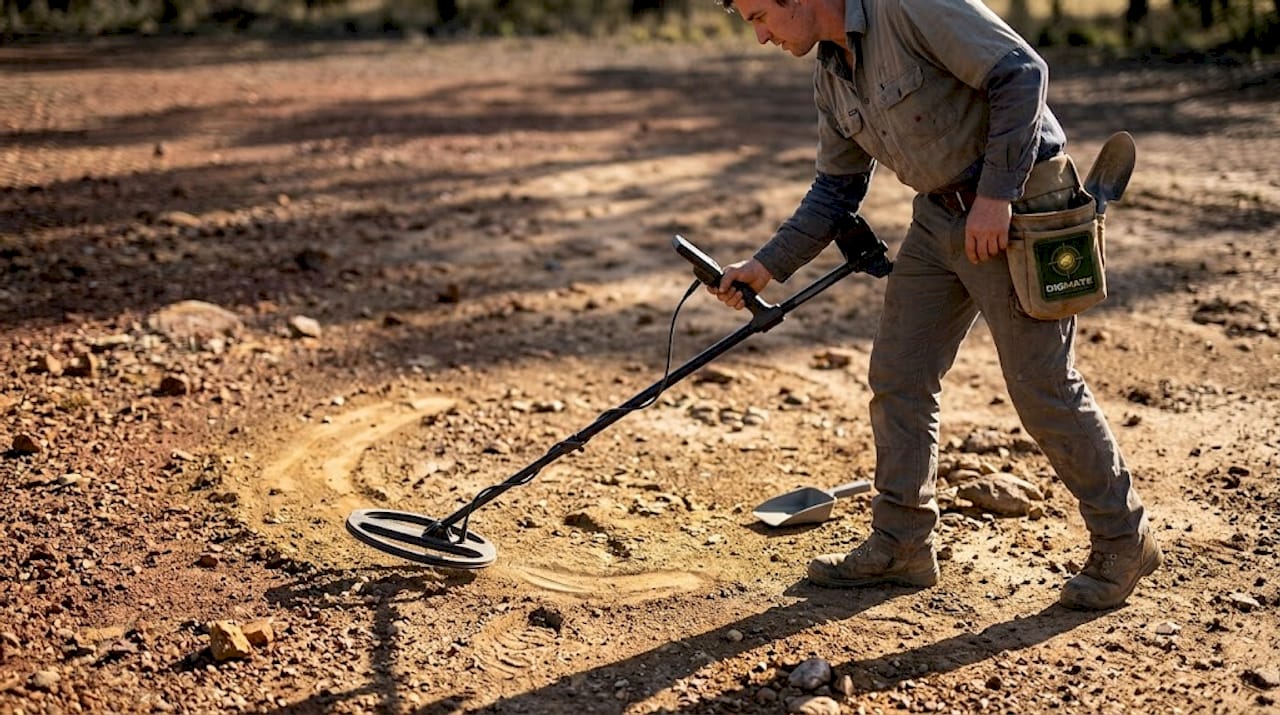
Sweeping is not just waving the coil back and forth. Consistent technique requires deliberate control at every pass. Follow these steps for maximum coverage and signal clarity:
- Maintain coil height: Keep the coil 1-2 inches above the ground surface. Lifting it higher reduces sensitivity dramatically. Dragging it creates false signals from ground contact.
- Overlap each sweep by 50%: Each pass should cover half the width of the previous one. This ensures no strip of ground is skipped between sweeps.
- Move slowly: Rushing your sweep reduces the time the coil spends over any target. Slow sweeps increase your chances on mineralized or hot ground where signals are already compressed.
- Listen for repeatability: A genuine gold signal repeats consistently from multiple sweep directions. Junk signals often break up or change tone when you approach from a different angle.
- Use VDI numbers as a guide: VDI 40-70 signals with a crisp, high-pitched repeatable tone indicate gold in most detector models.
Pro Tip: When you get a signal you are not sure about, rotate 90 degrees and sweep again. Gold responds consistently from all directions. Many junk targets do not.
Common sweeping mistakes include lifting the coil at the end of each pass (creating a banana arc that loses contact with the ground on the edges), moving too fast over hot ground, and ignoring faint signals. Faint signals are often deep gold or small nuggets, not noise.
For a structured breakdown of these methods, the metal detector prospecting techniques guide covers advanced audio interpretation in detail. You can also review prospecting best practices specific to NSW and Victoria conditions.
Select the optimal detector: PI vs VLF explained
To maximize your gold finds, choosing the right detector architecture is essential. The two main technologies available to prospectors are PI (Pulse Induction) and VLF (Very Low Frequency), and each has a distinct advantage depending on your target ground.
| Feature | PI Detectors | VLF Detectors |
|---|---|---|
| Mineralization handling | Excellent | Moderate to poor |
| Depth on large gold | Superior | Limited |
| Sensitivity to small gold | Moderate | High (at high frequency) |
| Cost | High ($2,000+) | Low to mid ($300-$1,500) |
| Best use case | Deep gold, severe mineralization | Small shallow nuggets, clean ground |
| Popular models | GPX6000, GPZ 7000 | Gold Monster 1000, Equinox 800 |
PI detectors excel in severe mineralization compared to VLF for small and shallow gold, with the GPX6000 and GPZ 7000 offering depth advantages and the Gold Monster 1000 serving as a beginner VLF at 45kHz.
Here is when each detector type earns its place in your kit:
- Choose a PI detector when: You are working deep, heavily mineralized ground in the Central Victorian goldfields or the New England region of NSW; you are targeting larger, deeper nuggets; or you have already worked an area with a VLF and want to go deeper.
- Choose a VLF detector when: You are working shallow alluvial ground, creek beds, or areas with lower mineralization; you are hunting fine or small gold near the surface; or you are new to detecting and working within a tighter budget.
For guidance on finding productive locations that match your detector's strengths, research the geology before committing to a site. Understanding the alluvial gold tools and techniques used in creek and river environments also helps you match your equipment to the ground type.
Field strategies for gold-rich sites and overlooked targets
Applying the right strategy in the field multiplies your chances. Site selection and knowing where others have left gold behind is as important as any piece of gear you carry.
Reworking old patches is one of the most underrated tactics in Australian prospecting. Experienced detectorists often pass through an area quickly with large coils, missing shallow or small targets entirely. Reworking old, trashy or shallow areas with small coils reveals missed gold that larger coils passed over. This is especially true in the Ballarat and Bendigo regions of Victoria, where gold was mined intensively but never completely exhausted.
Here are proven tactics for site research and patch hunting:
- Cross-reference old mining records with modern topographic maps to identify historically productive areas
- Use AI mapping tools to overlay geospatial data on known gold-bearing formations
- Check for legal access through state mining registries before entering any site in NSW or Victoria
- Look for exposed quartz reefs, ironstone contacts, and ancient creek lines as primary targets
- Work the edges of known patches where previous detectorists stopped, not just the center
| Region | Typical gold type | Best detection method |
|---|---|---|
| Central Victoria (Ballarat, Bendigo) | Shallow alluvial and reef gold | VLF high frequency or small coil PI |
| New England NSW | Deep ironstone-hosted nuggets | PI with large DD coil |
| Lachlan Fold Belt NSW | Fine alluvial and small nuggets | High-frequency VLF |
| Northeast Victoria (Beechworth) | Mixed alluvial and deep nuggets | PI or dual-coil approach |
For smart mineral exploration tips that combine traditional fieldwork with digital tools, integrating AI-driven mapping into your pre-trip research can cut wasted time dramatically. Browse the full range of gold prospecting guides to find region-specific advice for your next outing.
Why detection skill beats equipment in gold prospecting
Here is an uncomfortable truth most gear reviews will not tell you: an experienced prospector with a mid-range detector will consistently outperform a beginner with a top-tier machine. Equipment matters, but skill is the multiplier.
We have seen it repeatedly in the field. Someone picks up a GPZ 7000, rushes their sweeps, ignores faint signals, and walks away with nothing. Meanwhile, a seasoned operator with a Gold Monster 1000 and a small coil works the same patch slowly and methodically, pulling out three nuggets the first person missed entirely.
The habits that separate good operators from great ones are not glamorous. It is the discipline to slow down when the ground gets hot. It is the patience to dig every repeatable signal, even the faint ones. It is the willingness to adapt your site approach when the ground changes beneath you rather than sticking rigidly to one method.
Every outing teaches you something if you pay attention. Misread signals, dug targets, and empty holes are data points, not failures. The prospectors who refine their technique after each session are the ones who build a genuine edge over time.
Level up your prospecting with DigMate tools
Putting these strategies into practice is where DigMate becomes your competitive advantage in the field. The platform combines AI-driven mineral detection, geospatial mapping, and ground scanning tools built specifically for NSW and Victoria prospectors.

With DigMate, you can research productive sites before you leave home, overlay geological data on live maps, and use ground scan features to identify high-potential zones faster than manual research allows. Whether you are planning your first outing or refining a proven patch, the tools are built to support every stage of your process. Explore DigMate AI features to see what is available, access the free gold prospecting map for your region, or try the DigMate ground scan tool to bring precision to your next session.
Frequently asked questions
What's the key to detecting small gold nuggets in highly mineralized ground?
Use a small coil and set your ground balance manually to stabilize your threshold in mineral-rich soil. This combination picks up small nuggets in trashy or heavily mineralized areas that automatic settings and large coils routinely miss.
How do I know if a signal is likely to be gold?
A crisp, high-pitched repeatable signal in the VDI 40-70 range is a strong indicator of gold. Confirm it by sweeping from multiple directions and checking that the signal holds consistently.
Which type of metal detector should I use for deep or highly mineralized ground?
A PI detector handles severe mineralization and reaches deeper gold better than a VLF in most Australian goldfield conditions. PI detectors excel in severe mineralization where VLF units struggle to maintain a stable threshold.
Can I find gold in areas that have already been detected?
Absolutely. Using small coils in old, trashy areas consistently reveals nuggets that larger coils missed on previous passes. Modern detectors with better sensitivity also recover targets that older technology could not resolve.