
TL;DR:
- Up to 75 million ounces of undiscovered gold may still be beneath Victoria's surface. Modern technology like AI mapping and satellite data enhances exploration beyond historical methods. Victoria offers diverse mineral opportunities, including gold, gemstones, and critical minerals, with accessible tools for prospectors.
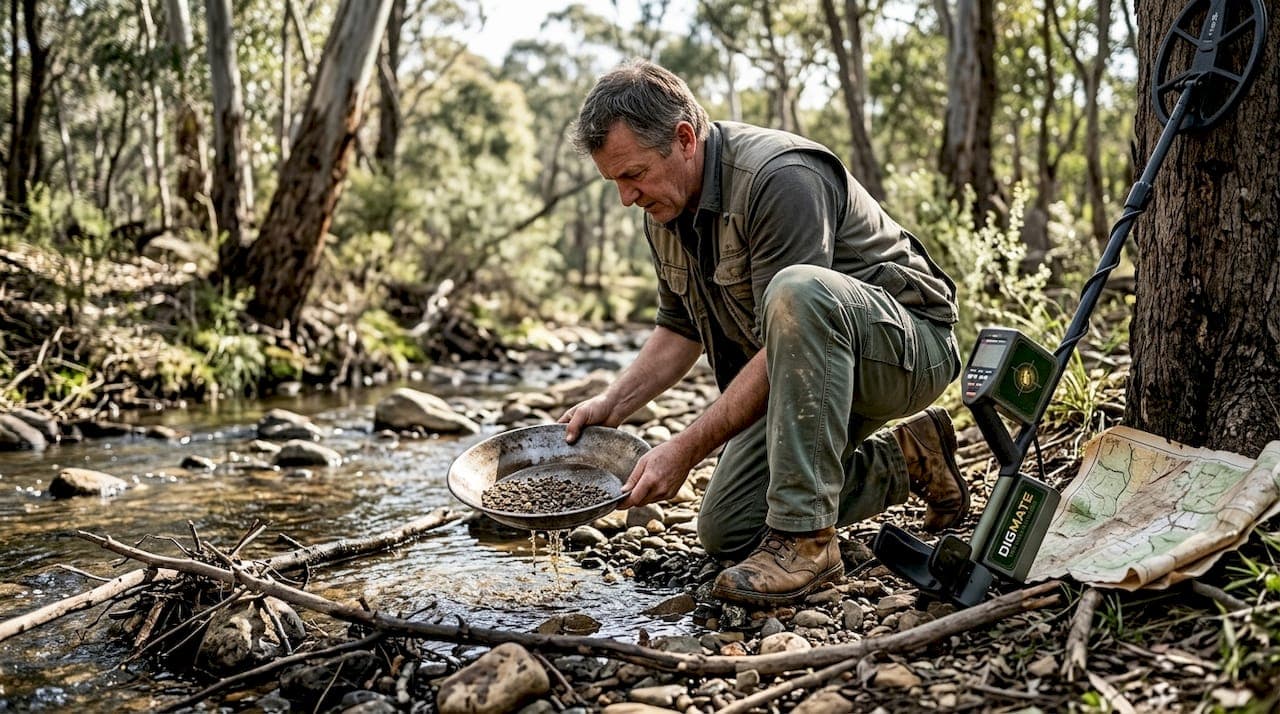
Up to 75 million ounces of undiscovered gold may still lie beneath Victoria's soil, concentrated across the Stawell, Bendigo, and Melbourne zones. Most outsiders assume the gold rush era closed the book on Victoria's mineral wealth. It didn't. What changed is how you find it. Modern prospectors are combining AI-driven mapping, satellite data, and deep geological analysis to locate deposits that earlier generations simply couldn't detect. This guide covers why Victoria remains one of the world's most compelling exploration destinations, what minerals you can realistically target, and which tools and strategies give you a real edge in the field today.
Table of Contents
- Victoria's unique mineral legacy and future opportunity
- Geological diversity: More than just gold
- Tools and technologies: How modern prospectors get ahead
- Field realities: What makes Victoria's exploration unique
- Why savvy explorers see Victoria differently
- Take your next step: Smarter prospecting in Victoria
- Frequently asked questions
Key Takeaways
| Point | Details |
|---|---|
| Huge untapped potential | Victoria holds an estimated 75 million ounces of undiscovered gold and large reserves of critical minerals. |
| Advanced tools lead | AI, satellite imagery, and geological databases give modern prospectors a major edge in Victoria. |
| Diverse mineral wealth | Beyond gold, Victoria is rich in gemstones and essential critical minerals including antimony and rare earths. |
| Success needs strategy | Effective prospecting in Victoria balances legacy knowledge with smart fieldwork and robust data analysis. |
Victoria's unique mineral legacy and future opportunity
Victoria's reputation as a mineral powerhouse isn't hype. It's backed by hard numbers. The state is a world-renowned gold province with over 2,500 tonnes of historical production, equivalent to more than 80 million ounces pulled from 13 major goldfields over more than 150 years. That record puts Victoria in genuinely elite company globally.
But here's what makes this more than a history lesson: current gold production sits at around 650,000 ounces per annum, primarily from high-grade deposits. The state is still actively producing at scale. The shift from surface-level alluvial rushes to technologically advanced deep exploration means the game has changed, not ended.
Key mineral zones and their significance:
- Bendigo Zone: World-class reef gold and underexplored depth extensions
- Stawell Zone: High-grade orogenic gold systems with modern drill targets
- Melbourne Zone: Emerging deep leads and poorly tested structural corridors
- Murray Basin fringe: Critical minerals and mineral sands with growing commercial interest
| Zone | Primary mineral | Exploration stage |
|---|---|---|
| Bendigo | Reef gold | Advanced, deep extensions remain |
| Stawell | Orogenic gold | Active drilling programs |
| Melbourne | Deep lead gold | Early to mid-stage |
| Murray Basin | Rare earths, mineral sands | Early stage, high potential |
Review Victoria mineral exploration tips before heading out to any of these zones. Understanding the structural geology of each area sharpens your targeting considerably.
"The best exploration opportunities in Victoria today aren't at the surface. They're below shallow cover that earlier prospectors couldn't penetrate."
For anyone targeting gold in Bendigo specifically, the structural controls on ore are well-documented, which means good data translates directly into better site choices. Victoria's critical mineral story is just beginning to attract serious attention, and that creates early-mover advantages for explorers who pay attention to the full picture.
Geological diversity: More than just gold
Gold dominates the conversation, but limiting your focus to gold alone means leaving real value in the ground. Victoria's geology is genuinely diverse, and that diversity creates opportunity across multiple commodity types.
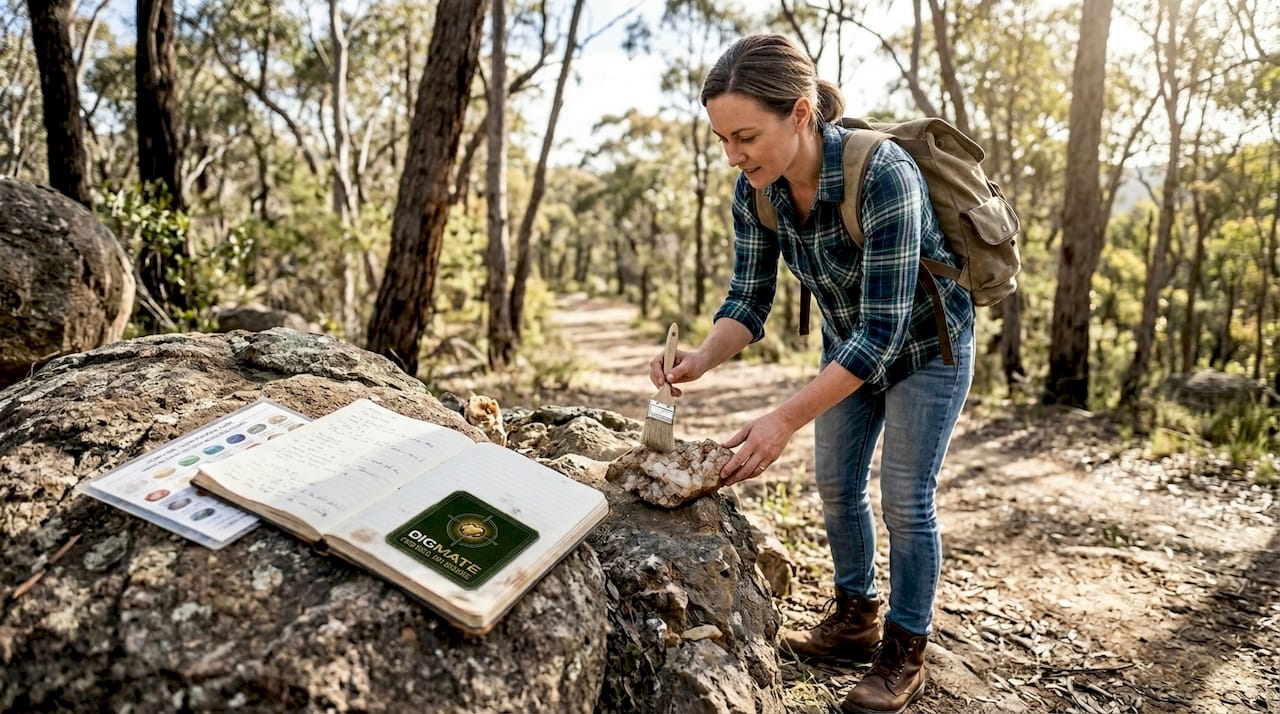
On the gem side, Victoria is rich in gemstones including quartz varieties, sapphires, diamonds, topaz, zircon, and turquoise, many of which turn up in alluvial gold deposits. If you're working a gold field and recovering concentrates, you're already in territory where gem finds are legitimate possibilities. Learn more about practical approaches through Victoria gem prospecting resources that cover both tools and field strategies.
| Mineral type | Typical location | Detection method |
|---|---|---|
| Alluvial gold | Creek beds, ancient channels | Metal detector, panning |
| Reef gold | Quartz veins, hard rock | Drilling, geophysics |
| Sapphires, zircon | Alluvial fields, basaltic areas | Sluicing, visual recovery |
| Rare earths | Murray Basin sediments | Geochemical sampling |
| Titanium, zirconium | Mineral sands, coastal plains | Bulk sampling, drilling |
On the critical minerals front, Victoria holds substantial potential for antimony, rare earths in the Murray Basin, titanium, and zirconium. These aren't fringe commodities. Global demand for rare earths and critical minerals is climbing fast, driven by battery technology and defense supply chains. Victoria's position in that market is underappreciated.
Why this matters for your prospecting strategy:
- Alluvial zones often yield multiple commodity types simultaneously
- Basaltic regions in western Victoria are proven gem-bearing environments
- Critical mineral targets require different data sets but are often co-located with gold zones
- Victoria gemstone details show a wider range of recoverable gems than most prospectors realize
Good site selection in Victoria means knowing which commodity you're primarily targeting and then building your search parameters around the geology that hosts it. Cross-commodity awareness simply makes you more effective in the field.
Tools and technologies: How modern prospectors get ahead
Knowing what you're after is step one. Knowing how to find it efficiently is where most prospectors either gain ground or waste months.
Step-by-step tool progression for Victoria:
- Secure your Miner's Right before any fossicking activity. This is the legal baseline for recreational and small-scale prospecting.
- Review GeoVic data to identify historical workings, geochemical anomalies, and geophysical coverage in your target area.
- Select your detection method based on deposit type: metal detectors for alluvial gold, ground-penetrating radar or induced polarization surveys for deeper targets.
- Layer in satellite imagery to map surface geology, vegetation anomalies, and drainage patterns that indicate mineralized zones.
- Apply AI prospectivity models to rank targets before committing time in the field.
The Victoria Geological Survey provides world-class pre-competitive geoscientific data through the GeoVic platform, including geophysical surveys, drillhole databases, and geochemical datasets. This is free public data that professional companies use. You should too.
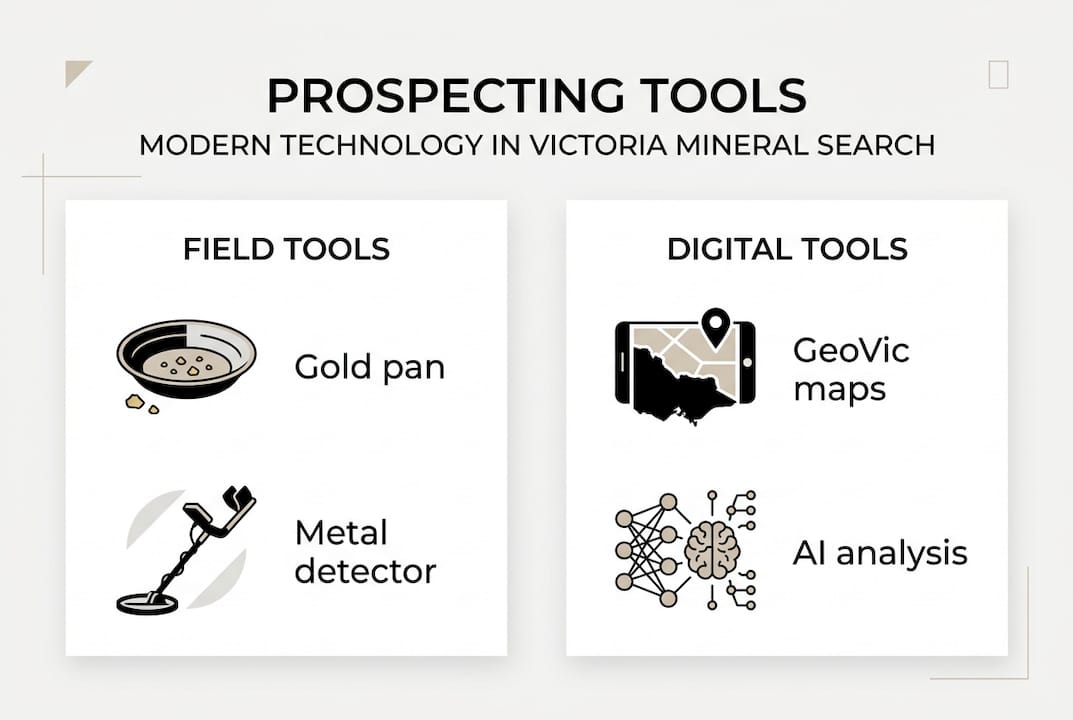
Understanding why geodata matters for prospecting success fundamentally changes how you approach site selection. It's not about where someone found gold in 1860. It's about what the current data says about structural controls and untested corridors.
| Tool | Best use case | Skill level needed |
|---|---|---|
| Metal detector | Alluvial gold, shallow reef | Beginner to intermediate |
| Ground geophysics (IP, EM) | Deep targets, sulfide-hosted gold | Advanced, specialist |
| GeoVic platform | Pre-field data review | Intermediate |
| AI prospectivity mapping | Target ranking, prioritization | Intermediate with guidance |
| Satellite imagery analysis | Surface feature mapping | Intermediate |
Pro Tip: Before heading out, cross-reference GeoVic geophysical anomalies against historical alluvial workings. Overlapping signals consistently produce the highest-confidence field targets in Victoria. Explore AI tools for minerals and check comparisons of the best metal detector options for Australian conditions.
Field realities: What makes Victoria's exploration unique
Having the right tools matters. So does knowing what you're actually walking into when you get to the field.
Victoria's goldfields split into two very different operational environments. Shallow alluvial deposits in creeks and ancient channels are accessible and well-documented, but the nugget effect creates a real sampling challenge. Gold distribution in alluvial settings is extremely uneven. A spot that yields nothing after 50 samples might produce results with 100. Dense, systematic sampling isn't optional here. It's how you separate productive ground from barren patches.
Deep cover exploration in northern Victoria presents different challenges. Younger sediments blanket older mineralized basement, making traditional surface methods nearly ineffective. Geophysics and deep geological data become essential tools rather than optional add-ons.
Practical field realities to factor in:
- Historical records point to general areas, not specific targets. Treat them as starting hints, not ground truth.
- Permit requirements vary by land type. Crown land, private property, and national parks each carry different rules.
- Victoria's excellent infrastructure including skilled workforce availability, transport networks, and utilities makes larger-scale operations more viable here than in many other Australian states.
- Seasonal conditions affect access in the high country and some western plains areas.
"The biggest waste in Victoria's goldfields isn't equipment or permits. It's driving hours to a site that five minutes of data review would have eliminated."
Pro Tip: Never anchor your field program to historical maps alone. Cross-check them against current geophysical data through GeoVic. Historical records reflect what was found with 19th-century technology, not what's actually there.
Understanding how geology drives gold finding in Victoria puts you ahead of prospectors who rely purely on folklore and old reports. Apply gold prospecting best practices to build a systematic approach that removes guesswork from your field decisions.
Why savvy explorers see Victoria differently
Most people who underestimate Victoria are still thinking about the 1850s gold rush. That mental model is costing them real opportunity. The contrast between legacy approaches and modern, data-driven exploration is stark, and it's widening every year as technology improves.
Expert prospectors don't just use better tools. They ask better questions. Instead of "where did people find gold before," they ask "what geological structure controls mineralization here, and has it been adequately tested at depth?" That shift in framing leads directly to better targeting.
The critical minerals pivot is creating a second layer of opportunity that most recreational prospectors completely ignore. Victoria's rare earth and antimony potential isn't fully mapped. Early-stage attention to those targets now positions you well ahead of the curve.
Combining legacy field wisdom with current AI-driven models and GeoVic datasets is not optional for serious explorers anymore. It's table stakes. Prospectors who rely on smarter prospecting tips and data integration consistently outperform those who don't, not because they're luckier, but because they eliminate unproductive ground faster and commit resources where the geology actually supports a find. Now is the right time to act. The data infrastructure exists, the technology is accessible, and the undiscovered potential is very real.
Take your next step: Smarter prospecting in Victoria
Victoria's mineral opportunity is real, documented, and accessible to anyone willing to combine solid fieldwork with the right data tools. The challenge is connecting the right information to the right locations without spending weeks digging through raw geological databases.

DigMate is built exactly for this. The DigMate prospecting platform brings together AI-driven mineral detection, mapped geospatial data, and prospecting insights specific to Victoria and New South Wales. Whether you're a professional explorer or a dedicated hobbyist, DigMate helps you target smarter, move faster, and avoid the wasted effort that kills momentum in the field. Start with the free Victoria gold map to see active and historical gold zones overlaid with modern prospectivity data.
Frequently asked questions
Is gold still being found in Victoria?
Yes. Active operations are producing around 650,000 ounces of gold annually in Victoria, with significant new discoveries remaining possible in underexplored zones.
What kinds of gemstones can you find while prospecting in Victoria?
Victoria's alluvial fields yield quartz, sapphires, diamonds, topaz, zircon, and turquoise, often recovered alongside gold in creek and channel deposits.
What is the 'nugget effect' in Victoria's goldfields?
The nugget effect describes highly uneven gold distribution in alluvial deposits, which means dense, systematic local sampling is required to accurately assess whether a site is productive.
Are advanced tools like AI and satellite imagery used in Victoria?
Yes. Professionals increasingly rely on AI prospectivity mapping and satellite imagery to rank targets and reduce time spent on low-potential ground across Victoria.
What permissions do I need to prospect for minerals in Victoria?
A Miner's Right license is required for recreational fossicking, while exploration drilling and commercial operations require separate exploration or mining licenses issued by the state government.